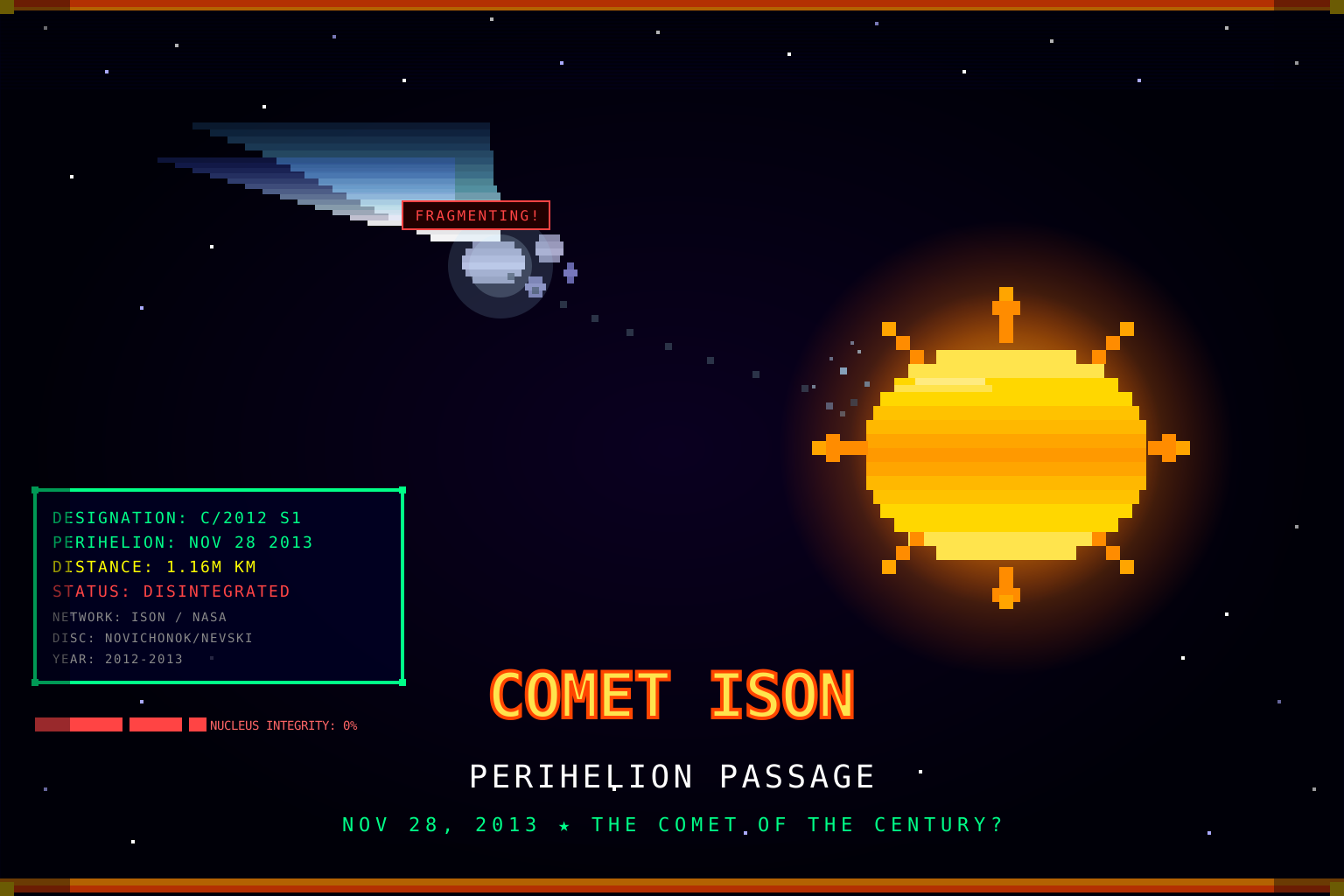
Key figures: Artyom Novichonok and Vitali Nevski (International Scientific Optical Network, discoverers); Karl Battams (NASA Comet ISON Observing Campaign spokesperson); NASA Solar Dynamics Observatory and Hubble Space Telescope teams; ESA Solar and Heliospheric Observatory (SOHO); Jian-Yang Li and Matthew Knight (planetary scientists, University of Maryland)
Summary
Comet ISON, formally designated C/2012 S1 (ISON), was discovered on September 21, 2012, by astronomers Artyom Novichonok and Vitali Nevski using the International Scientific Optical Network (ISON) telescope at Kislovodsk Mountain Astronomical Station in Russia. On November 28, 2013, the comet reached perihelion — its closest approach to the Sun — passing roughly 1.16 million kilometers (about 730,000 miles) above the solar surface, well within the Sun’s outer corona. Astronomers worldwide anticipated ISON would become the brightest comet in decades — potentially the “Comet of the Century” — reaching naked-eye brightness rivaling the full Moon in November 2013.
The comet’s actual behavior diverged sharply from predictions. As ISON approached the Sun, tidal forces and intense solar heating caused the nucleus to fragment. The comet did not achieve the predicted brilliance and appeared to almost completely disintegrate at perihelion, though diffuse remnants were detected in ultraviolet wavelengths for several days afterward. The 2013 apparition became a landmark case study in the unpredictability of cometary behavior and the difficulty of forecasting brightness from orbital mechanics alone.
Discovery and Orbital Characteristics
Comet ISON was discovered at a distance of approximately 6.25 AU (935 million kilometers) from the Sun — well beyond the orbit of Jupiter. At discovery, the comet had an apparent magnitude of approximately 18.8, far beyond naked-eye or binocular visibility, and required professional-grade telescopes for detection.
ISON is classified as a dynamically new comet: a long-period comet on its first visit to the inner solar system from the Oort Cloud, the distant reservoir of cometary bodies extending to roughly 100,000 AU from the Sun. Dynamically new comets often display heightened early activity because their surface volatiles — water ice, carbon monoxide, carbon dioxide — have never been exposed to solar heating. This makes them initially bright but potentially fragile, since the same pristine volatiles that produce vigorous outgassing have never been processed into the more durable crusts seen in returning comets.
Orbital calculations established:
- Perihelion date and time: November 28, 2013, at 18:48 UTC
- Perihelion distance: approximately 1.86 million km from the Sun’s center (0.0124 AU); with the Sun’s radius approximately 695,700 km, this placed ISON roughly 1.16 million km above the solar surface, deep within the corona
- Orbital inclination: 61.9 degrees to the ecliptic plane
- Orbital period: approximately 10,000 years or greater (consistent with Oort Cloud origin; some models suggested a hyperbolic escape trajectory after perihelion, meaning ISON would not return)
- Eccentricity: approximately 0.99999 — nearly parabolic
ISON is a sungrazer but, contrary to some early reporting, is not a member of the Kreutz group — the family of comets (including the Great Comets of 1843, 1882, and 1965’s Ikeya-Seki) thought to be fragments of a single large progenitor. Kreutz sungrazers share a distinctive orbital signature; ISON’s orbital elements differ substantially.
NASA’s Comet ISON Observing Campaign (CIOC)
Beginning in 2012, NASA organized the Comet ISON Observing Campaign (CIOC), a coordinated multi-observatory effort to monitor ISON from discovery through perihelion and beyond. The CIOC involved:
- Hubble Space Telescope: Obtained high-resolution images tracking the evolution of ISON’s nucleus and coma from April 2013 onward, contributing key data on the fragmentation timeline.
- NASA Solar Dynamics Observatory (SDO): Monitored ISON in extreme ultraviolet (EUV) wavelengths as it passed through the Sun’s corona near perihelion on November 28–29, 2013.
- ESA/NASA SOHO (Solar and Heliospheric Observatory): SOHO’s LASCO (Large Angle and Spectrometric Coronagraph) cameras — which block direct sunlight to observe the solar corona — tracked ISON’s inbound trajectory and emergence (or non-emergence) from perihelion in near-real-time.
- NASA STEREO spacecraft: NASA’s twin Solar TErrestrial RElations Observatory spacecraft, positioned in leading and trailing solar orbits, provided additional viewing angles on ISON before and after perihelion.
- Amateur astronomers worldwide: Thousands of amateur observers tracked ISON through October and November 2013, contributing light-curve photometry and visual observations to CIOC databases.
The CIOC was among the most organized multi-platform observing campaigns ever mounted for a single comet. CIOC spokesperson Karl Battams maintained public updates through NASA blogs and social media, creating unusually high public visibility for the event.
Brightness Timeline and Pre-Perihelion Observations
ISON’s brightness deviated from early predictions as it approached the Sun:
| Date | Approximate Magnitude | Notes |
|---|---|---|
| Sep 2012 (discovery) | ~18.8 | Faint; required professional telescope |
| Early 2013 | ~14–15 | Still below naked-eye threshold |
| Oct 2013 | ~10–11 | Faint naked-eye under ideal dark skies |
| Nov 1, 2013 | ~8–9 | Binocular object; developing coma |
| Nov 14–18, 2013 | ~5–6 | Marginal naked-eye; coma visible |
| Nov 19–27, 2013 | Variable; brightness plateaued | Fragmentation slowing brightening |
| Nov 28 (perihelion) | ~-2 briefly, then faded | Peak near perihelion; rapid fading |
| Dec 1, 2013 | ~5–6 (remnants) | Diffuse debris; no coherent nucleus |
By mid-November 2013, ISON’s brightness was tracking below most predictions. The comet had been expected to reach magnitude -2 to -4 (rivaling Venus or Jupiter) by late November; instead, it stalled around magnitude 5–7 — visible to the naked eye only under dark skies, not the spectacle that had been forecast.
Hubble observations in late October and early November 2013 detected that ISON’s nucleus had rotational brightness variations consistent with irregular tumbling and partial fragmentation, suggesting structural instability before perihelion.
Perihelion Passage: Disintegration or Survival?
As ISON reached perihelion on November 28, 2013, observers around the world — and SOHO’s LASCO cameras — tracked its fate in real time. In the hours leading to perihelion, ISON appeared to brighten suddenly, fueling brief excitement that the nucleus had survived. However:
- Pre-perihelion brightening (Nov 27–28): The comet reached an apparent magnitude near -2 as it approached the Sun, visible in SOHO’s corona cameras — but this brightening was consistent with the destruction of the nucleus releasing all its volatile material at once (“death brightening”), not intact survival.
- Perihelion passage (18:48 UTC, Nov 28): SOHO images showed the comet passing through the coronagraph’s field of view but emerging as a dramatically fainter, diffuse object rather than a coherent bright comet.
- Uncertain hours (Nov 28–29): For several hours, the scientific community and public were uncertain whether ISON’s nucleus had survived. Social media and news sites reported conflicting accounts. NASA’s CIOC team issued cautious statements that the comet “may have survived” before later concluding that the nucleus had disintegrated.
- Final assessment: SOHO’s LASCO and SDO images confirmed that ISON’s nucleus had fragmented and vaporized almost completely. A diffuse cloud of cometary debris — largely dust and gas — continued along ISON’s trajectory for several days, briefly detectable in ultraviolet wavelengths by NASA’s STEREO spacecraft, but no coherent nucleus remained.
Post-Perihelion: Remnant Observations
In early December 2013, observers using sensitive telescopes detected diffuse remnants of ISON moving outward from the Sun. These remnants:
- Were visible primarily in ultraviolet wavelengths due to the extreme luminosity of cometary gas excited by solar radiation.
- Faded rapidly and were below useful observational limits by December 10–14, 2013.
- Did not exhibit any coherent nuclear condensation — confirming that the comet’s solid nucleus had been destroyed.
The brightness of the remnant field was estimated at magnitude 7–9 in early December, requiring binoculars under dark skies. By December 26, even the most sensitive professional telescopes could not detect ISON’s remnants.
Scientific Legacy and Contributions
Despite failing to deliver a naked-eye spectacle, ISON’s 2013 perihelion passage yielded significant scientific returns:
- Dynamically new comet fragility: ISON confirmed that first-time Oort Cloud visitors, while initially active, are susceptible to disintegration near perihelion — particularly sungrazers. Prior models had been uncertain about the survival probability of dynamically new sungrazers; ISON provided a well-observed case study in near-total nucleus destruction.
- Pre-perihelion activity and composition: Spectroscopic observations of ISON during 2013 detected water, carbon dioxide, carbon monoxide, and ethylene in the coma — data contributing to understanding of primordial comet composition and the delivery of volatile organics to the early inner solar system.
- Real-time scientific communication: The CIOC’s unprecedented public transparency — live updates, social media commentary, open data sharing — became a model for multi-mission astronomical observing campaigns. The public involvement in observing ISON demonstrated that cometary events can generate mass scientific engagement.
- Models of cometary survival near the Sun: ISON informed updated calculations of the tensile strength of cometary nuclei and the critical perihelion distances at which fragmentation becomes likely. These models apply to future sungrazing comets, including Kreutz-group members observed by SOHO each year.
The comet’s public story — hyped as the “Comet of the Century” and then failing to deliver — also illustrated a challenge of science communication: predictions of comet brightness carry inherent uncertainty that is difficult to convey to a general audience accustomed to confident forecasts.
Comet Nomenclature
ISON’s formal designation C/2012 S1 (ISON) follows the International Astronomical Union (IAU) scheme:
- C/ — nonperiodic comet (orbital period greater than 200 years; not expected to return within human timescales)
- 2012 — year of discovery
- S1 — first comet discovered in the second half of September (period S) 2012
- (ISON) — discoverer organization (International Scientific Optical Network)
Under current conventions, comets discovered by automated survey networks are named for the network, not individual observers — a departure from the historical tradition of naming comets for their individual discoverers (e.g., Comet Halley, Comet Hale-Bopp). Novichonok and Nevski are credited as co-discoverers but the formal name reflects the network affiliation.
Relationship to Other 2013 Astronomical Events
Comet ISON’s perihelion on November 28, 2013 was one of several notable astronomical and scientific milestones of the year. Earlier in 2013, the February 15 Chelyabinsk meteor event — a superbolide that exploded over Russia with an energy equivalent to roughly 500 kilotons — had dramatically raised public awareness of near-Earth objects and underscored the importance of tracking small solar system bodies. In particle physics, CERN’s 2013 confirmation of the Higgs boson’s identity at the Large Hadron Collider carried forward the landmark 2012 discovery announcement; see CERN Confirms Discovery of Higgs Boson for that parallel milestone in the year’s science.
Sources
- Comet ISON (C/2012 S1) — NASA Comet ISON Observing Campaign
- Comet ISON — ESA / SOHO Space Mission
- Comet ISON: What Happened? — NASA Jet Propulsion Laboratory
- Comet ISON — Wikipedia
- CIOC: Comet ISON Observing Campaign reports — Sungrazing Comets (Karl Battams / NASA)
- Light-curve analysis of Comet C/2012 S1 (ISON) — Astronomy & Astrophysics (2014)
- Kreutz Family Comets and Sungrazers — Minor Planet Center
- Britannica: Comet ISON