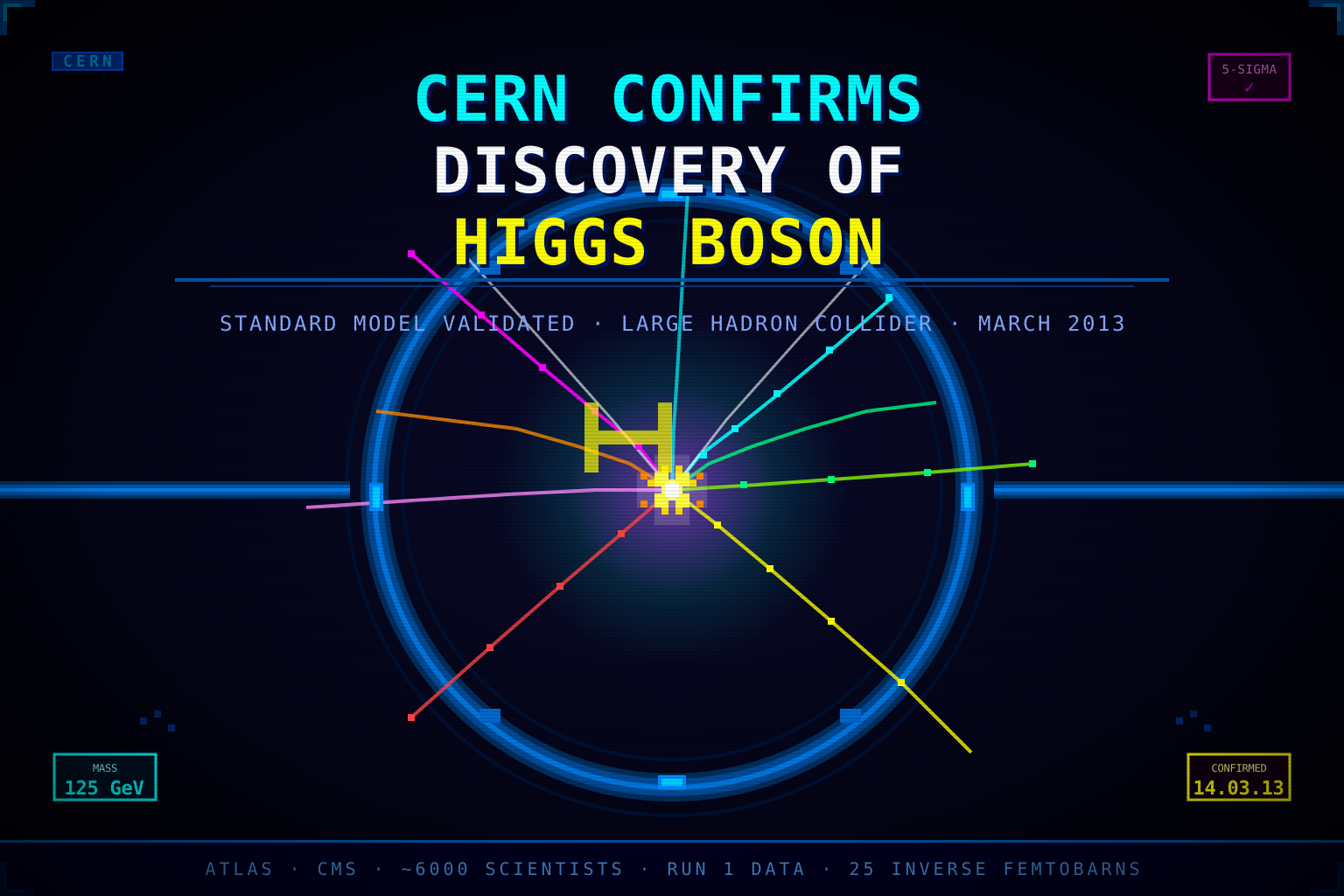
Key figures: Peter Higgs, François Englert, Robert Brout (deceased 2011), Rolf Heuer (CERN Director-General), Joe Incandela (CMS spokesperson), Fabiola Gianotti (ATLAS spokesperson), ATLAS and CMS experimental collaborations (~6,000 scientists total)
Summary
On March 14, 2013, CERN announced that analysis of data from the Large Hadron Collider (LHC) confirmed the discovery of a Higgs boson — a fundamental particle predicted 50 years earlier by theoretical physicists but never experimentally observed until July 2012. The confirmation represented one of the most significant scientific achievements of the early twenty-first century, validating the Standard Model of particle physics and establishing the mechanism by which fundamental particles acquire mass.
Initial hints of the Higgs boson had emerged on July 4, 2012, when the ATLAS and CMS experiments independently reported the observation of a new particle with a mass of approximately 125 GeV (gigaelectronvolts). By March 2013, after analyzing approximately 25 inverse femtobarns of LHC collision data collected during Run 1 — roughly 2.5 times more than the July 2012 dataset — both experiments concluded with statistical significance exceeding 5 sigma that the particle was indeed a Higgs boson.
The confirmation required ruling out alternative theoretical possibilities for the particle’s spin-parity properties. By measuring the angular distributions of the Higgs boson’s decay products across multiple channels, the experiments demonstrated that the particle has spin-0 and positive parity — precisely the quantum numbers predicted by the Standard Model Higgs. Alternative hypotheses (spin-2 or spin-1 particles) were excluded at greater than 99.9% confidence.
The Theoretical Prediction (1964)
In the summer of 1964, the theoretical physics community converged on a solution to a fundamental puzzle: the equations of the Standard Model required all gauge bosons to be massless, yet the W and Z bosons that mediate the weak nuclear force were empirically known to be extraordinarily massive (~80–91 GeV). This contradiction threatened to make the entire electroweak theory mathematically inconsistent.
Between June and October 1964, three separate groups published independent solutions:
- François Englert and Robert Brout (Université Libre de Bruxelles, published June 26, 1964)
- Peter Higgs (University of Edinburgh, published October 31, 1964)
- Gerald Guralnik, C.R. Hagen, and Tom Kibble (Imperial College London, published November 16, 1964)
All three proposed that the universe is filled with a quantum field — the Higgs field — that permeates all of space. As the universe cooled after the Big Bang, this field underwent spontaneous symmetry breaking: it acquired a non-zero vacuum expectation value of approximately 246 GeV, and particles that interact with it acquired mass proportional to the strength of that interaction. The W and Z bosons, which interact strongly with the Higgs field, are heavy; photons, which do not interact with it, are massless.
The theory predicted the existence of a new particle — the Higgs boson — the quantum excitation of the Higgs field itself. Without direct experimental confirmation, the Higgs boson remained theoretical for 48 years, and the “Higgs mechanism” was considered one of the most important untested predictions in twentieth-century physics.
The Large Hadron Collider: Construction and Design
To observe the Higgs boson, physicists required collision energies at least an order of magnitude beyond any previous accelerator. The LHC, straddling the France-Switzerland border near Geneva, was built specifically to search for the Higgs and to explore physics beyond the Standard Model.
Key facts about the LHC:
- Circumference: 26.7 kilometers (16.6 miles)
- Construction cost: approximately CHF 7.5 billion (~$9 billion USD) for the accelerator alone; ~$13.25 billion including detectors
- Construction period: approved 1994, first proton beams achieved September 10, 2008
- Collision energy: designed for 14 TeV center-of-mass; Run 1 (2010–2013) operated at 7 TeV (2010–2011) and 8 TeV (2012–2013)
- Proton speed: 99.9999991% of the speed of light
- Temperature: the LHC’s superconducting magnets operate at 1.9 K (−271.3 °C), colder than outer space, requiring 96 metric tons of liquid helium to maintain
Protons travel in two opposing beams, guided by 1,232 superconducting dipole magnets and focused to a beam width of approximately 64 micrometers at collision points — thinner than a human hair. The collision points are surrounded by the four major detectors: ATLAS, CMS, LHCb, and ALICE.
The ATLAS and CMS Experiments
Two independent experiments, ATLAS (A Toroidal LHC Apparatus) and CMS (Compact Muon Solenoid), were specifically designed to search for the Higgs boson.
ATLAS weighs approximately 7,000 metric tons and measures 46 meters long and 25 meters high — roughly the size of a seven-story building. It involves approximately 3,000 physicists and engineers from 183 institutions across 38 countries.
CMS weighs approximately 14,000 metric tons — the heaviest of the four LHC detectors — measuring 21 meters long and 15 meters high. Its central feature is a superconducting solenoid magnet generating a field 100,000 times stronger than Earth’s magnetic field. CMS involves approximately 4,000 physicists and engineers from 200 institutions across 42 countries.
Detecting the Higgs required sifting through roughly 600 million proton-proton collisions per second. The data reduction was extreme: hardware triggers immediately discarded all but ~1 in 100,000 events; software triggers further reduced this by a factor of ten. Of the interactions that passed all filters, the analyses had to distinguish genuine Higgs decays from billions of background events produced by ordinary QCD processes.
Higgs Boson Decay Channels
The Higgs boson is unstable and decays almost instantaneously (lifetime ~1.6 × 10⁻²² seconds) into lighter particles. At a mass of 125 GeV, the Standard Model predicts specific decay modes with known probabilities (branching ratios):
| Decay Channel | Notation | Branching Ratio (approx.) | Notes |
|---|---|---|---|
| Bottom quark pair | H → bb̄ | ~58% | Most common; hardest to isolate from background |
| W boson pair | H → WW* | ~21% | Used in discovery; one W off-shell |
| Tau lepton pair | H → ττ | ~6.3% | Important for fermion coupling measurement |
| Z boson pair | H → ZZ* | ~2.6% | “Golden channel” — cleanest signal |
| Photon pair | H → γγ | ~0.23% | Key discovery channel despite low rate |
| Muon pair | H → μμ | ~0.02% | Rare but measurable at HL-LHC |
The H → ZZ → 4 leptons and H → γγ channels were most important for the initial discovery because they produce narrow, distinctive peaks in invariant mass distributions against relatively smooth backgrounds. The 2013 confirmation extended the analysis to include H → WW and H → ττ channels, demonstrating coupling to fermions (not just gauge bosons) and ruling out exotic spin hypotheses.
The Worldwide LHC Computing Grid
Processing the LHC’s data required computing infrastructure on a scale unprecedented in science. The Worldwide LHC Computing Grid (WLCG), established in 2002, linked approximately 170 computing centers in 42 countries, providing a combined computing power of roughly 200,000 processor cores and 150 petabytes of storage capacity. Data produced at CERN was distributed in tiers to regional centers worldwide, enabling simultaneous analysis by thousands of physicists working from institutions across six continents.
The WLCG represented, as of 2013, the largest computing grid in the world dedicated to a single scientific project. Innovations developed for the LHC computing program — including grid middleware, distributed data management, and high-throughput physics analysis frameworks — influenced later developments in cloud computing and big data infrastructure more broadly.
Nobel Prize in Physics 2013
The significance of the Higgs discovery was recognized with exceptional speed. On October 8, 2013, the Royal Swedish Academy of Sciences awarded the Nobel Prize in Physics jointly to Peter Higgs and François Englert:
“for the theoretical discovery of a mechanism that contributes to our understanding of the origin of mass of subatomic particles, and which recently was confirmed through the discovery of the predicted fundamental particle, by the ATLAS and CMS experiments at CERN’s Large Hadron Collider.”
The prize was valued at 8 million Swedish kronor (~$1.25 million USD), divided equally between the two laureates. Robert Brout, Englert’s collaborator in the original 1964 prediction, had died on May 3, 2011, and was ineligible for a posthumous award; the Nobel committee’s decision to limit the physics prize to two recipients (rather than the permissible three) reflected the limits of the Nobel statutes rather than a judgment about scientific contribution.
The speed of the award — barely more than a year after the initial July 2012 announcement — reflected the unambiguous nature of the discovery and the prior decades of theoretical work that had made the Higgs boson a known prediction rather than a speculation.
Significance and Implications
Completing the Standard Model: The Higgs was the last undiscovered particle predicted by the Standard Model. With its confirmation, the 1970s-era theoretical framework that describes three of the four fundamental forces — electromagnetism, the weak nuclear force, and the strong nuclear force — was experimentally validated across all its components.
The 125 GeV mass and vacuum stability: The measured Higgs mass of ~125 GeV had profound cosmological implications. Theoretical calculations showed that at this specific mass, the universe’s electroweak vacuum exists in a metastable state — not absolutely stable, but so long-lived (estimated decay timescale many orders of magnitude longer than the current age of the universe, ~13.8 billion years) that it poses no practical concern for the observable cosmos. Nevertheless, the finding prompted extensive theoretical discussion about the ultimate fate of spacetime.
Scale of international collaboration: The ATLAS and CMS collaborations represented a new model for fundamental science. A discovery attributed to thousands of co-authors challenged conventional norms of scientific credit and demonstrated that the most profound questions in physics could only be addressed through sustained international institutional cooperation. The 2012 papers announcing the discovery in Physics Letters B listed roughly 3,000 author names each — among the most co-authored scientific papers ever published.
Technology spinoffs: Although the Higgs boson itself had no immediate application, LHC-related R&D produced advances in superconducting magnet technology, radiation-hard detector materials, real-time data processing, and particle beam therapy for cancer treatment. CERN’s accelerator technology for medical hadron therapy had, by 2013, been deployed in clinical cancer treatment centers across Europe.
Ongoing Questions
The 2013 confirmation marked a beginning, not an endpoint. Outstanding questions included:
- Is this the only Higgs boson? Supersymmetric extensions of the Standard Model predict five or more Higgs-like particles.
- Are its couplings precisely Standard Model? Any deviation would indicate new physics; by 2013, all measured couplings were consistent with Standard Model predictions within experimental uncertainties.
- What is the connection to dark matter? The Standard Model does not include dark matter; Higgs-sector modifications might.
- Why is the Higgs mass so low? The theoretical “hierarchy problem” — why quantum corrections don’t push the Higgs mass to the Planck scale (~10¹⁶ GeV) — remained unresolved and pointed toward physics beyond the Standard Model.
LHC Run 2 (2015–2018) and Run 3 (2022–2025), operating at 13–13.6 TeV, continued probing these questions. No significant deviations from Standard Model predictions had been found as of the knowledge cutoff date, making the Higgs sector one of the most precisely measured and theoretically consistent aspects of fundamental physics — and one of the most powerful arguments that the Standard Model, for all its known incompleteness, remains a remarkable approximation of nature.
Like the rollout of Google Glass in the same year (see Google Glass Launch), the Higgs confirmation demonstrated 2013 as a year of landmark technology and science milestones, though the two operated on vastly different timescales: consumer technology measured in product cycles, fundamental physics in decade-long experiments.
Sources
- New results indicate that particle discovered at CERN is a Higgs boson — CERN
- The Higgs Boson — CERN
- The 2013 Nobel Prize in Physics — NobelPrize.org
- Peter Higgs & François Englert win Nobel Prize for Physics — UCL News
- How the Higgs Boson Was Found — Smithsonian Magazine
- Observation of a new boson at a mass of 125 GeV (CMS) — Physics Letters B, 2012
- Observation of a new particle in the search for the Standard Model Higgs boson (ATLAS) — Physics Letters B, 2012
- Worldwide LHC Computing Grid — CERN