Key figures: Omar al-Bashir (President of Sudan), Jan Egeland (UN Under-Secretary-General), Colin Powell (U.S. Secretary of State), Kofi Annan (UN Secretary-General), Janjaweed militias
Background
The Darfur conflict erupted in February 2003 when two Black African rebel groups — the Sudan Liberation Army (SLA) and the Justice and Equality Movement (JEM) — took up arms against the Arab-dominated government in Khartoum, citing decades of political marginalization and economic neglect of Sudan’s western region. The Sudanese government responded not only with its own military forces but by arming and coordinating Arab nomadic militias, collectively known as the Janjaweed, to carry out a counterinsurgency campaign against civilian Black African populations (predominantly the Fur, Masalit, and Zaghawa ethnic groups) from whom the rebel movements drew support.
The Crisis in 2005
Scale of Displacement and Death
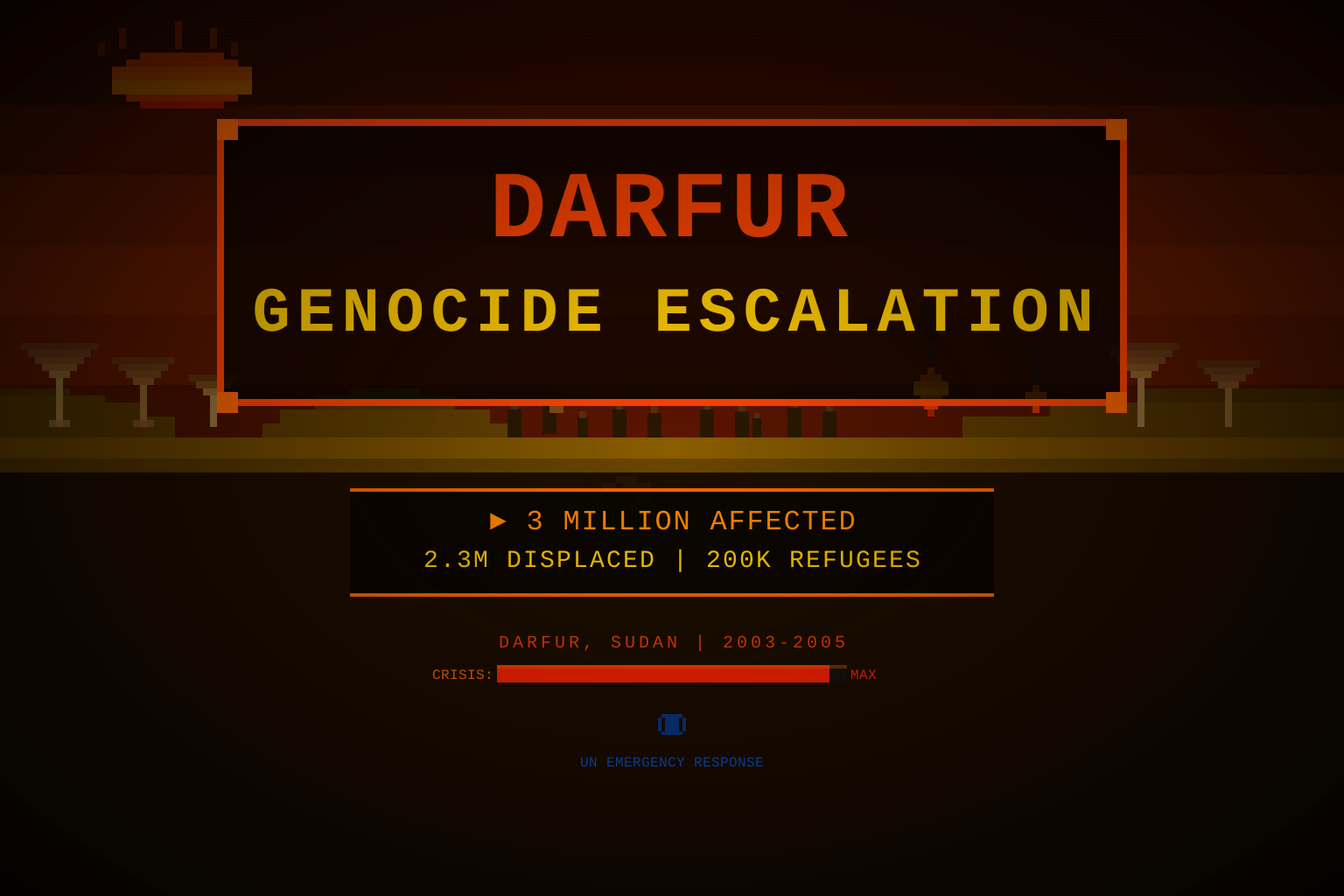
By early 2005, the humanitarian toll had reached catastrophic proportions. The UN estimated that more than 2.3 million people had been internally displaced within Darfur, while approximately 200,000 additional refugees had fled across the border into eastern Chad. In total, over 3 million people had been affected by the conflict. Crowded camps at Kalma, Zam Zam, and Abu Shouk in North Darfur became cities of the desperate, with populations swelling faster than aid agencies could deliver food, water, or medicine.
Mortality estimates were hotly contested but consistently alarming. The World Health Organization put cumulative conflict-related deaths — including those from disease and malnutrition in camps — at approximately 300,000 by 2005, though the Sudanese government disputed such figures. The UN’s own emergency relief coordinator Jan Egeland described the situation in January 2005 as the world’s worst humanitarian crisis, warning that unless conditions improved rapidly, camp death rates could rise catastrophically.
Pattern of Attacks
Survivor accounts and independent investigations documented a distinctive and systematic method of attack. Janjaweed militias would arrive on horseback and camels — sometimes accompanied by Sudanese Armed Forces vehicles and helicopters — surrounding villages before dawn. Aircraft would bomb the settlement to scatter residents, followed by mounted militia who would kill men and older boys, abduct women and girls for sexual violence, loot livestock and valuables, and systematically burn homes, food stores, and water sources. The comprehensive destruction of agricultural infrastructure — wells poisoned, granaries burned, donkeys slaughtered — was designed not merely to displace but to make return impossible.
The UN Commission of Inquiry, established by UN Security Council Resolution 1564 on September 18, 2004, released its report in January 2005 concluding that while the attacks met the threshold of crimes against humanity, the commissioners stopped short of declaring it genocide under the technical legal definition — partly because proving genocidal intent in a legal sense remained difficult. Nonetheless, the systematic targeting based on ethnicity was unambiguous.
U.S. Declaration of Genocide
In a landmark statement on September 9, 2004, U.S. Secretary of State Colin Powell testified before the Senate Foreign Relations Committee that the United States had concluded that genocide was occurring in Darfur — making the United States the first government to formally apply that designation to the crisis. Powell’s declaration was politically significant: the Genocide Convention of 1948 technically obligates signatory states to act to prevent and punish genocide. However, Powell simultaneously announced no new policy measures, acknowledging that the declaration carried no automatic enforcement mechanism. The paradox of naming genocide without triggering intervention became a focal point of international human rights debate throughout 2005.
The U.S. Congress had passed a concurrent resolution in July 2004 declaring Darfur a genocide, giving Powell’s executive-branch declaration additional political weight. But the Bush administration’s foreign policy priorities — managing the Iraq War and pursuing the Comprehensive Peace Agreement in southern Sudan — limited appetite for a third major African commitment.
International Response and Its Limits
The African Union Mission in Sudan (AMIS), deployed in mid-2004, expanded to approximately 7,700 troops and police by late 2005, but operated under a restricted mandate: monitoring rather than protecting, and lacking both the logistical capacity and political authority to confront the Janjaweed. AU personnel documented attacks they were powerless to stop, filing reports that accumulated into a vast evidentiary record but produced little immediate relief for civilian populations.
At the UN Security Council, diplomatic action was repeatedly hamstrung. China, a major purchaser of Sudanese oil (accounting for roughly 60–70% of Sudan’s oil exports in this period), and Russia both resisted resolutions that would authorize coercive measures against Khartoum. China’s position — emphasizing national sovereignty and non-interference in internal affairs — reflected both commercial interests and a broader foreign policy doctrine. The resulting Security Council resolutions were limited to demands, referrals, and mild sanctions rather than enforcement.
On March 31, 2005, the Security Council passed Resolution 1593 referring the Darfur situation to the International Criminal Court (ICC) — the first such referral in ICC history. Sudan, not being a signatory to the Rome Statute, was compelled to cooperate, though the Bashir government refused to do so in practice. The referral laid the groundwork for eventual ICC indictments, including the historic March 4, 2009 indictment of President Omar al-Bashir for war crimes, crimes against humanity, and genocide — the first sitting head of state to be so charged.
Abuja Peace Talks
Parallel to the ongoing violence, political negotiations proceeded in Abuja, Nigeria, under African Union mediation. Talks between the Sudanese government, the SLA, and the JEM moved haltingly through 2005, hindered by government intransigence, rebel fragmentation, and the continued military pressure on civilian populations that undercut any incentive for compromise. A ceasefire signed in April 2004 had never held in practice. The Abuja process would eventually produce the Darfur Peace Agreement on May 5, 2006, but with only one rebel faction signing, its implementation remained contested.
Significance
The Darfur crisis of 2005 became a defining test of post-Cold War international institutions and the emerging norm of the Responsibility to Protect (R2P), formally adopted at the UN World Summit in September 2005. R2P held that sovereignty was not a shield against accountability when a state was perpetrating or failing to prevent mass atrocities against its own population. Darfur demonstrated the gap between the principle’s adoption and its implementation, as political calculations at the Security Council repeatedly blocked effective action.
The crisis also galvanized civil society organizations worldwide. In the United States, the Save Darfur Coalition — founded in 2004 — became one of the most prominent human rights advocacy campaigns of the decade, mobilizing students, religious communities, and celebrities and pushing the genocide designation into mainstream political discourse.
Domestically, al-Bashir’s regime survived international pressure but paid a long-term political cost. In 2019, he was ousted by a popular uprising and military coup, and as of 2026 Sudan continues to face renewed mass atrocities in a conflict that tragically echoes Darfur’s pattern.
Related Topics
- 31st G8 Summit at Gleneagles (July 2005) — Africa aid and debt relief dominated the agenda, with Darfur a backdrop to broader discussions of African development and governance
- 7/7 London Bombings (July 2005) — competed for international humanitarian attention in a crowded news year
- Camp Casey Protest (August 2005) — reflected broader anti-war and humanitarian dissatisfaction with Bush administration foreign policy