Overview
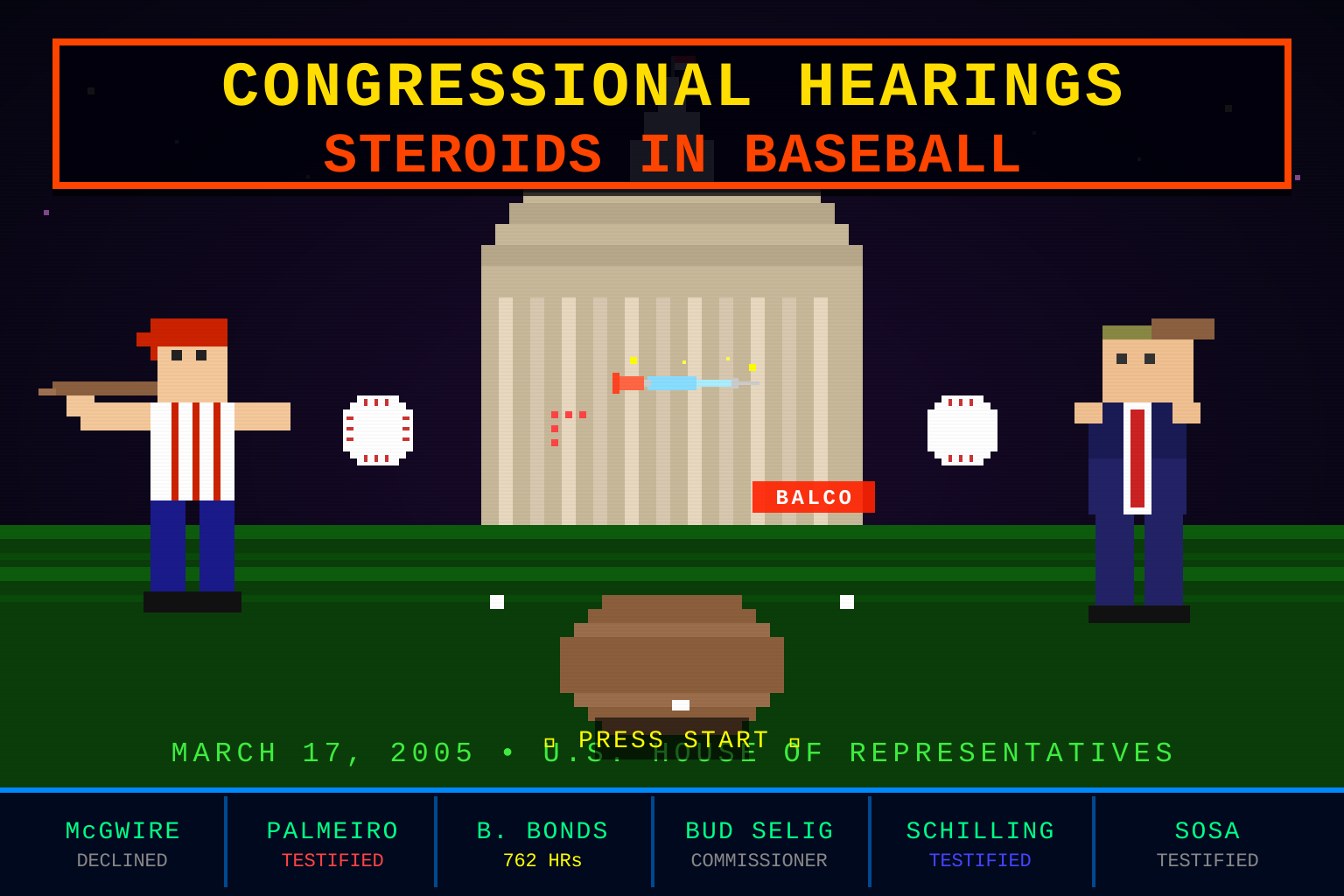
On 17 March 2005, the U.S. House Government Reform Committee held a nationally televised hearing on steroid use in Major League Baseball. Convened amid mounting public concern over performance-enhancing drugs and the ongoing federal Bay Area Laboratory Co-Operative (BALCO) investigation, the hearing brought several of the sport’s biggest stars before Congress under oath and became one of the defining public moments of baseball’s “steroid era.”
The session crystallized a debate — over records, player health, and the integrity of the game — that would shadow baseball for the rest of the decade. It came at a moment when the era’s central figure, San Francisco Giants outfielder Barry Bonds, was closing on the sport’s most storied home run records, ensuring that every milestone to follow would be framed by suspicion as well as celebration.
The March 17 Hearing
The hearing was chaired by Representative Tom Davis, with Representative Henry Waxman as ranking member. It featured testimony from a panel of current and former players: Mark McGwire, Sammy Sosa, Rafael Palmeiro, Curt Schilling, and Frank Thomas (the last appearing by video link), alongside baseball officials including Commissioner Bud Selig and players’ union head Donald Fehr.
The players’ testimony produced several enduring images:
- Mark McGwire, who had broken the single-season home run record in 1998, repeatedly declined to answer questions about his own past, telling the committee, “I’m not here to talk about the past.” His evasive, emotional appearance was widely interpreted as an implicit admission and badly damaged his public reputation.
- Sammy Sosa, McGwire’s 1998 rival, was represented by a lawyer and answered through a statement and a translator, despite having conducted English-language interviews throughout his career.
- Rafael Palmeiro pointed his finger emphatically at the committee and declared, “I have never used steroids. Period.” The denial would be discredited within months.
- Curt Schilling and Frank Thomas, who had spoken out against steroid use, offered comparatively cooperative testimony.
The hearing was watched by a national audience and marked the first time baseball’s stars faced sustained public questioning on the issue under oath.
The BALCO Scandal
The hearing unfolded against the backdrop of the BALCO investigation, the most consequential drug case in American sports of the era. The Bay Area Laboratory Co-Operative, based in Burlingame, California, was raided by federal agents on 3 September 2003 after founder Victor Conte was found to be distributing a then-undetectable designer steroid called “the clear” (tetrahydrogestrinone, or THG) to elite athletes across multiple sports.
Conte’s client list spanned track-and-field athletes (including Marion Jones and Tim Montgomery), NFL players, and baseball players — most prominently Barry Bonds, whose personal trainer Greg Anderson was a central BALCO distributor. Anderson pleaded guilty in 2005 to steroid distribution and money laundering and served time in prison; he later returned to jail repeatedly for refusing to testify against Bonds.
Bonds had testified before the federal grand jury in December 2003, stating that he did not knowingly use performance-enhancing drugs — testimony that became the basis of his 2007 federal indictment for perjury and obstruction of justice. After years of legal proceedings, Bonds was convicted on one count of obstruction of justice in April 2011; an eleven-judge en banc panel of the Ninth Circuit Court of Appeals vacated that conviction in 2015, ruling the evidence insufficient.
Barry Bonds and the 2001 Single-Season Record
The player at the center of the era’s controversy was Bonds. In 2001, at age 36, he hit 73 home runs, breaking Mark McGwire’s record of 70 (set in 1998) and setting a single-season MLB mark that still stands. His on-base percentage of .515 and slugging percentage of .863 that year are also MLB records. Bonds won four consecutive National League Most Valuable Player awards from 2001 to 2004, an unprecedented achievement.
Bonds’s late-career power surge — accelerating sharply after age 35 — became the central exhibit in arguments that performance-enhancing drugs had transformed his statistics, alongside documented changes in his physique. These observations, combined with testimony from BALCO associates, formed the evidentiary backbone of the federal case against him.
The Home Run Records, 2005–2007
The March 2005 hearing occurred as Bonds approached the career records held by Babe Ruth (714) and Hank Aaron (755). Bonds had ended the 2004 season with 703 career home runs. His 2005 season, however, was wrecked by a series of arthroscopic surgeries and an infection in his right knee: he did not appear until 12 September and played only 14 games, hitting five home runs to finish the year with 708.
It was therefore in 2006, not 2005, that Bonds reached Ruth’s total. On 20 May 2006 he hit his 714th home run — off Oakland Athletics pitcher Brad Halsey — to tie Ruth, and on 28 May 2006 his 715th, off Colorado Rockies pitcher Byung-Hyun Kim at San Francisco’s AT&T Park, to pass him. On 7 August 2007 Bonds hit his 756th home run off Washington Nationals pitcher Mike Bacsik, breaking Aaron’s all-time record. He finished his major league career after the 2007 season with 762 home runs.
For historical context: Ruth had retired in 1935 with 714 home runs, a total that stood as the MLB record for 39 years until Hank Aaron of the Atlanta Braves hit his 715th on 8 April 1974, off Los Angeles Dodgers pitcher Al Downing, before a crowd of 53,775. Aaron finished his career in 1976 with 755. Aaron, who had endured death threats and racist hate mail during his own pursuit of Ruth, offered only a brief pre-recorded video acknowledgment when Bonds broke his record in 2007.
Aftermath and Legacy
The hearings had immediate consequences. In August 2005, Rafael Palmeiro — who had so emphatically denied steroid use in March — was suspended after testing positive for the anabolic steroid stanozolol, an outcome that discredited the hearing’s most forceful denial and lent urgency to reform.
Under congressional pressure, Major League Baseball substantially strengthened its drug-testing and penalty regime, adopting tougher sanctions for the 2006 season. In 2006, Commissioner Bud Selig commissioned former U.S. Senator George J. Mitchell to conduct an independent investigation; the resulting Mitchell Report, released in December 2007, named dozens of players and detailed the scope of performance-enhancing drug use across the sport.
The era’s records remain among the most contested in baseball history. Bonds and other steroid-era stars were repeatedly passed over by Baseball Hall of Fame voters in the annual balloting; Bonds’s ten years of eligibility (2013–2022) ended without induction, though the debate over how the sport should narrate the period — whether such records should be accepted, annotated, or set apart from those of the pre-testing era — continued into the 2010s and 2020s.
Related
- Michael Jackson acquitted — another 2005 event involving a prominent American figure, legal proceedings, and divided public judgment.
- Lance Armstrong wins seventh Tour de France — another marquee 2005 athletic achievement later shadowed by doping revelations.
- Super Bowl XXXIX — a major American sporting event of early 2005.
- Australian cricket dominance and the 2005 Ashes — a contemporaneous sporting story with a contrasting, celebratory tone.
Sources
- Fainaru-Wada, Mark and Lance Williams. Game of Shadows: Barry Bonds, BALCO, and the Steroids Scandal That Transformed Baseball. Gotham Books, 2006.
- U.S. House Committee on Government Reform. Restoring Faith in America’s Pastime: Evaluating Major League Baseball’s Efforts to Eradicate Steroid Use. Hearing transcript, March 17, 2005.
- Mitchell, George J. Report to the Commissioner of Baseball of an Independent Investigation into the Illegal Use of Steroids and Other Performance Enhancing Substances by Players in Major League Baseball. Office of the Commissioner of Baseball, December 13, 2007.
- Baseball Reference. “Barry Bonds Statistics.” baseball-reference.com. Career statistics and game logs.