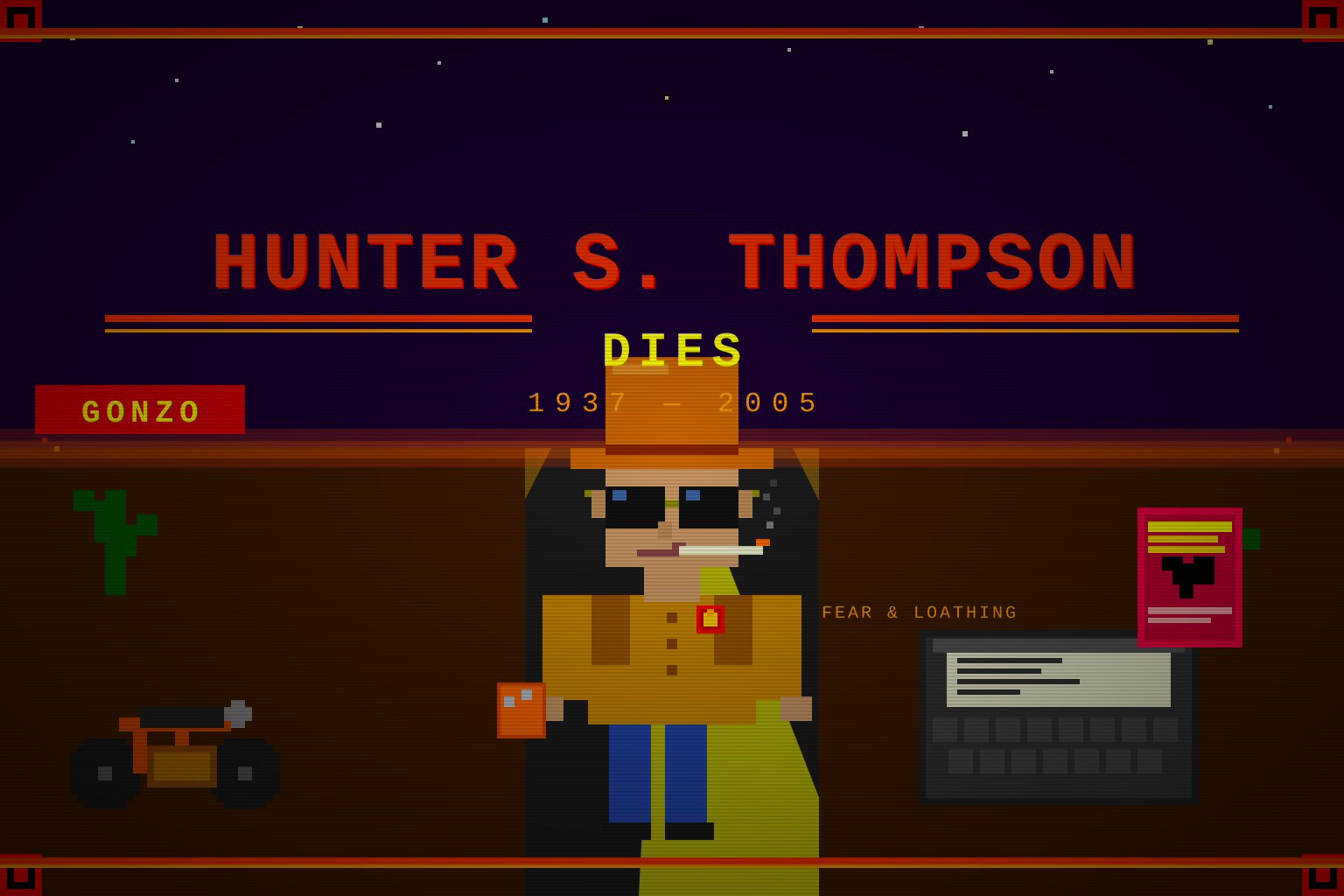
Key figures: Hunter S. Thompson, Ralph Steadman (illustrator collaborator), Jann Wenner (Rolling Stone founder/editor), Johnny Depp (friend and patron), Juan Thompson (son)
Life and Career
Hunter Stockton Thompson was born on July 18, 1937, in Louisville, Kentucky, into a working-class family. An adolescent with a passion for literature — he typed out entire novels by F. Scott Fitzgerald and Ernest Hemingway to absorb their style — Thompson enlisted in the U.S. Air Force in 1956 and served as a sports editor for a base newspaper before receiving an early discharge in 1958. He spent the late 1950s and early 1960s as a struggling freelance journalist in Puerto Rico, South America, and California, developing the immersive, first-person style that would become his signature.
Rise to Prominence: Hell’s Angels and Gonzo
Thompson’s breakthrough came with Hell’s Angels: The Strange and Terrible Saga of the Outlaw Motorcycle Gangs (1966), the result of a year spent riding with the infamous motorcycle club. The book attracted national attention and established him as a writer willing to dissolve the boundary between observer and participant. He coined the term “Gonzo journalism” in 1970 — derived from a Boston Globe piece by Bill Cardoso describing Thompson’s first-person account of the Kentucky Derby for Scanlan’s Monthly — to describe his method of immersive, subjective reporting where the writer becomes a character in the story.
His 1971 masterpiece Fear and Loathing in Las Vegas, serialized in Rolling Stone and illustrated by British artist Ralph Steadman, blended a drug-fueled road trip narrative with corrosive satire of American materialism and the death of the 1960s counterculture. The book opens with its famous line: “We were somewhere around Barstow, on the edge of the desert, when the drugs began to take hold.” It sold modestly at first but became a cult classic that endures as one of the most distinctive works of American literary journalism.
Political Coverage and Rolling Stone
Founder Jann Wenner gave Thompson an unprecedented platform at Rolling Stone, where he served as national affairs editor. His coverage of the 1972 presidential campaign — later collected in Fear and Loathing: On the Campaign Trail ‘72 — was a landmark of political journalism, blending biting analysis with personal narrative. Thompson famously called Edmund Muskie a “treacherous brain-damaged old water-head” and predicted Richard Nixon’s landslide victory months before mainstream journalists acknowledged the possibility. His campaign coverage inspired a generation of political writers.
He ran for Sheriff of Pitkin County, Colorado, on the “Freak Power” platform in 1970, losing narrowly but demonstrating his belief that political engagement extended beyond commentary. His Aspen compound, Owl Farm, became a gathering place for writers, politicians, and celebrities throughout the 1970s and 1980s.
Later Career and ESPN Column
In his final years, Thompson wrote a weekly column, Hey Rube, for ESPN’s website (espn.com), covering the intersection of sports, politics, and culture. The column gave him a new audience and a late-career platform for commentary on the Bush administration’s foreign policy, the 2003 Iraq War, and what he saw as the collapse of American civic life. He remained deeply politically engaged, expressing contempt for what he described as the criminalization of American politics.
Death
Thompson died on February 21, 2005, at Owl Farm in Woody Creek, Colorado (near Aspen), from a self-inflicted gunshot wound to the head. He was 67 years old. His son Juan Thompson discovered him and found a note he had titled “Football Season Is Over”, written on February 16 — five days before his death — that expressed his philosophy: “No More Games. No More Bombs. No More Walking. No More Fun. No More Swimming. 67. That is 17 years past 50. 17 more than I needed or wanted. Boring. I am always bitchy. No Fun — for anybody. 67. You are getting Greedy. Act your old age. Relax — This won’t hurt.”
Thompson had suffered significant physical decline in his final years: a broken leg from a ski accident in 2003, hip replacement surgery, and spinal pain that severely limited his mobility. He had spoken throughout his life about suicide as a rational choice and had frequently stated that he would not allow himself to deteriorate into helplessness.
His longtime friend and collaborator Johnny Depp, who had portrayed Thompson in Terry Gilliam’s 1998 film adaptation of Fear and Loathing in Las Vegas and spent considerable time at Owl Farm, paid for Thompson’s funeral. In August 2005, at a memorial ceremony attended by celebrities including Jack Nicholson, Bill Murray, John Kerry, and Sean Penn, Depp funded the firing of Thompson’s ashes from a custom cannon built atop a 153-foot tower in the shape of a double-thumbed fist — Thompson’s personal symbol — at Owl Farm. The cannon shot was accompanied by fireworks and a rendition of “Mr. Tambourine Man.” The event reportedly cost approximately $2.5 million, largely funded by Depp.
Literary Legacy and Influence
Thompson’s influence on American journalism and literature is substantial and enduring:
- He permanently altered expectations for what first-person reporting could be, opening space for narrative nonfiction writers including Tom Wolfe, Joan Didion, and later writers of the immersive longform tradition.
- His political criticism — particularly his analysis of Nixon and the Vietnam-era power structure — remains a touchstone for political writing that combines visceral engagement with systemic critique.
- Fear and Loathing in Las Vegas has sold millions of copies and is routinely cited as one of the defining works of 20th-century American literature; it appeared in Modern Library’s readers’ list of the 100 best novels.
- His personal style — the aviator glasses, cigarette holder, and tropical shirts — became iconic shorthand for a certain kind of American rebel intellectual.
- Terry Gilliam’s 1998 film starring Johnny Depp and Benicio del Toro introduced Thompson to new generations, and a 2008 documentary, Gonzo: The Life and Work of Dr. Hunter S. Thompson, further cemented his legacy.
Related Topics
- Peter Jennings Dies (August 2005) — the same year claimed another giant of American journalism, though from opposite ends of the media spectrum
- W. Mark Felt Revealed as Watergate’s “Deep Throat” (May 2005) — another 2005 milestone in the history of American political journalism
- George W. Bush’s 2005 Second-Term Agenda — the political climate Thompson was critiquing in his final months