Key figures: Jimmy Wales, Larry Sanger, Wikipedia community volunteers, Encyclopædia Britannica
Origins: The Wiki Experiment
Wikipedia launched on January 15, 2001, as an adjunct project to Nupedia — an online encyclopedia that assigned articles to credentialed experts following a rigorous seven-stage peer-review process. Nupedia had managed to produce only a couple of dozen articles in its first year. Co-founders Jimmy Wales (a former futures-and-options trader who funded the project) and Larry Sanger (Nupedia’s editor-in-chief) introduced a wiki — a website anyone could edit — as a way to accelerate drafting. The experiment rapidly overshadowed the parent project: by the end of 2001, Wikipedia’s English edition had roughly 20,000 articles.
The model was radically different from anything that had come before: articles were written anonymously or pseudonymously by volunteers, edited and revised by anyone, and held to no credential requirement. Quality control emerged from the community itself — editors reverting vandalism, flagging disputed claims, and debating article content on associated “talk pages.” The system was chaotic, contentious, and, its supporters argued, self-correcting.
Growth Trajectory
Wikipedia’s English edition grew rapidly through its early years:
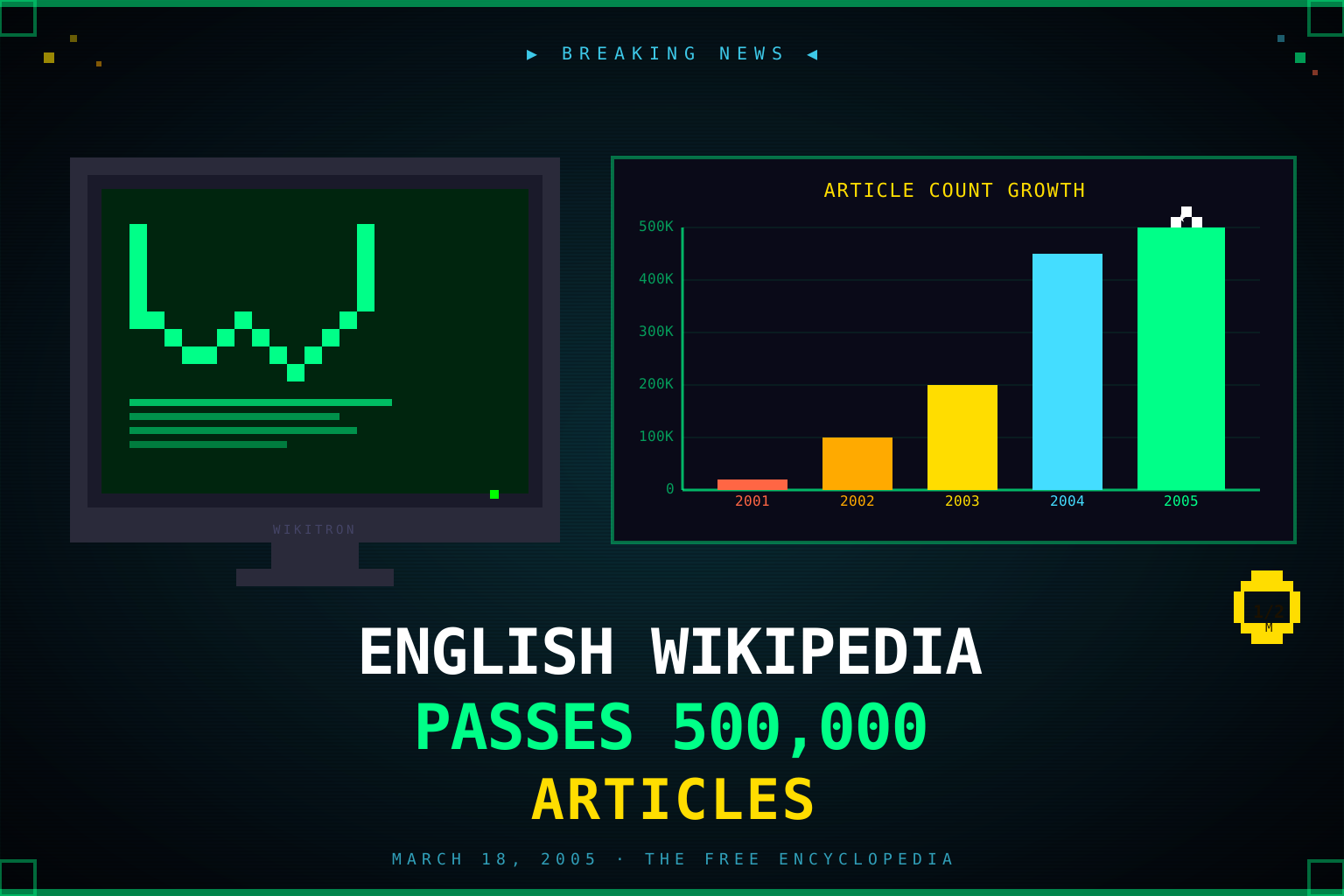
| Year | English Articles |
|---|---|
| 2001 | ~20,000 |
| 2002 | ~100,000 |
| 2003 | ~200,000 |
| 2004 | ~450,000 |
| 2005 (Mar 18) | 500,000 |
| 2005 (Sep 29) | ~750,000 |
The pace of growth — roughly doubling each year through 2004 — reflected both the broadening base of internet users and the increasing visibility of Wikipedia in search-engine results. By 2004, Wikipedia articles regularly appeared among the top Google results for many common queries. Each visitor who spotted an error or gap had a frictionless path to fix it. By the end of 2005 the English edition was approaching 900,000 articles, and it would cross the one-million mark on March 1, 2006, with an article on the Jordanhill railway station in Scotland.
The Half-Million Milestone
The English edition passed 500,000 articles on March 18, 2005. The Wikimedia Foundation — which Wales had established in 2003 as the non-profit host for Wikipedia and its sister projects — marked the occasion with a press release identifying the article on Involuntary settlements in the Soviet Union as the symbolic five-hundred-thousandth entry.
The choice of an academic, historically specialized topic as the landmark article made its own point: Wikipedia’s comprehensiveness was not limited to mainstream subjects. The encyclopedia contained detailed articles on video-game characters, minor railway stations, and small-town politicians alongside its coverage of major historical events — a breadth impossible for any traditionally curated reference work. The milestone attracted global press coverage and helped drive donations to the Wikimedia Foundation.
The Nature Study: Accuracy Under Scrutiny
The rapid growth coincided with increased scrutiny of Wikipedia’s accuracy. On December 14, 2005, the journal Nature published a peer-reviewed comparison of Wikipedia and Encyclopædia Britannica science articles. Reviewers examined 42 matched pairs of articles and found an average of roughly four errors per Wikipedia article versus three per Britannica article — a surprisingly small gap that generated worldwide headlines. Britannica contested the methodology in a formal rebuttal, but the study broadly supported Wikipedia’s accuracy claims relative to the established standard of reference publishing.
The Nature study was widely cited as evidence that Wikipedia’s crowd-sourcing model could produce knowledge of near-professional quality at scale. It accelerated the shift among academics, journalists, and policymakers toward using Wikipedia as a starting point for research — even as formal citation of Wikipedia remained discouraged in academic settings.
International Editions
By 2005, Wikipedia’s multilingual reach was extensive:
- German: the second-largest edition, notable for its relatively high standards for citations and article completeness
- Japanese, French, Polish, and Dutch editions each held tens of thousands to low hundreds of thousands of articles and were growing quickly
Editions existed in more than 100 languages by the end of 2005, including several constructed languages (Esperanto among them) and endangered languages used as preservation tools. The Wikimedia Foundation viewed the multilingual expansion as central to its mission: free knowledge in every language, not just English.
Community Governance
By 2005, Wikipedia’s English edition had developed a sophisticated, informal governance structure:
- Administrators: roughly a thousand trusted editors with tools to protect pages, block disruptive users, and delete articles. Admin status was granted by community consensus through formal processes.
- Arbitration Committee (ArbCom): a body of senior editors, created in December 2003, that resolved the most intractable disputes and handled user-conduct issues.
- Policies and guidelines: an extensive hierarchy of written policies (e.g., “Neutral Point of View,” “Verifiability,” “No Original Research”) that governed article content and editor conduct.
The governance model was simultaneously an achievement and a source of ongoing controversy. Critics argued that Wikipedia’s informal power structures favored experienced insiders, discouraged new contributors (especially women and contributors from the Global South), and produced systemic coverage gaps that mirrored the demographics of its editor base.
Controversies and Reliability Debates
The year’s growth unfolded against a backdrop of high-profile reliability controversies:
- In November 2005, journalist John Seigenthaler Sr. published a USA Today op-ed revealing that his Wikipedia biography had falsely implicated him in both Kennedy assassinations for some four months before the error was corrected — a case that prompted Wikipedia to restrict the creation of new articles by unregistered users.
- Wikipedia’s coverage of living persons became a sustained editorial battleground, eventually producing the “Biographies of Living Persons” policy that imposed stricter sourcing standards on such articles.
These controversies did not halt growth. If anything, they raised Wikipedia’s public profile and prompted improvements to its reliability mechanisms.
Significance
The half-million milestone marked Wikipedia’s transition from a promising experiment into an established reference of the first rank. Traditional encyclopedias such as Encyclopædia Britannica — whose print edition had taken decades to build and cost well over a thousand dollars for a set — were being operationally matched, in breadth and topicality, by a project that cost almost nothing to produce and belonged to no commercial entity.
The broader implications extended across digital culture. Wikipedia demonstrated that volunteer labor could sustain complex, large-scale intellectual infrastructure — an insight that influenced the open-source software movement, open-access academic publishing, and collaborative knowledge management in corporate settings. Its model of distributed peer review also anticipated the “wisdom of crowds” frameworks that shaped later social-media design, though Wikipedia’s quality controls were far more intentional than those of the platforms that followed.
By 2010, Wikipedia had become one of the ten most-visited websites in the world. By the 2020s its English edition contained more than six million articles, contributed by tens of millions of registered editors across all languages, while the Wikimedia Foundation continued to operate primarily on donations — making Wikipedia one of the most widely used and cost-efficient knowledge projects in history.
Related Topics
- Google Maps launches (2005) — a parallel 2005 milestone in open, web-native information infrastructure
- YouTube founded (2005) — another 2005 platform built on user-generated content
- Digital music revolution (2005) — the broader 2005 shift toward participatory, web-based media
- MGM v. Grokster decided (2005) — a defining 2005 fight over the law of internet-era technology
- The Sony BMG rootkit scandal (2005) — a contemporaneous test of trust and openness on the digital web
Sources
- Wikipedia: Milestones
- Wikinews: English Wikipedia passes 500 thousand article milestone
- Giles, Jim. “Internet Encyclopaedias Go Head to Head.” Nature 438, 900–901 (2005)
- Seigenthaler, John. “A False Wikipedia ‘Biography’.” USA Today, November 29, 2005
- Wikimedia press release: 500,000 English articles