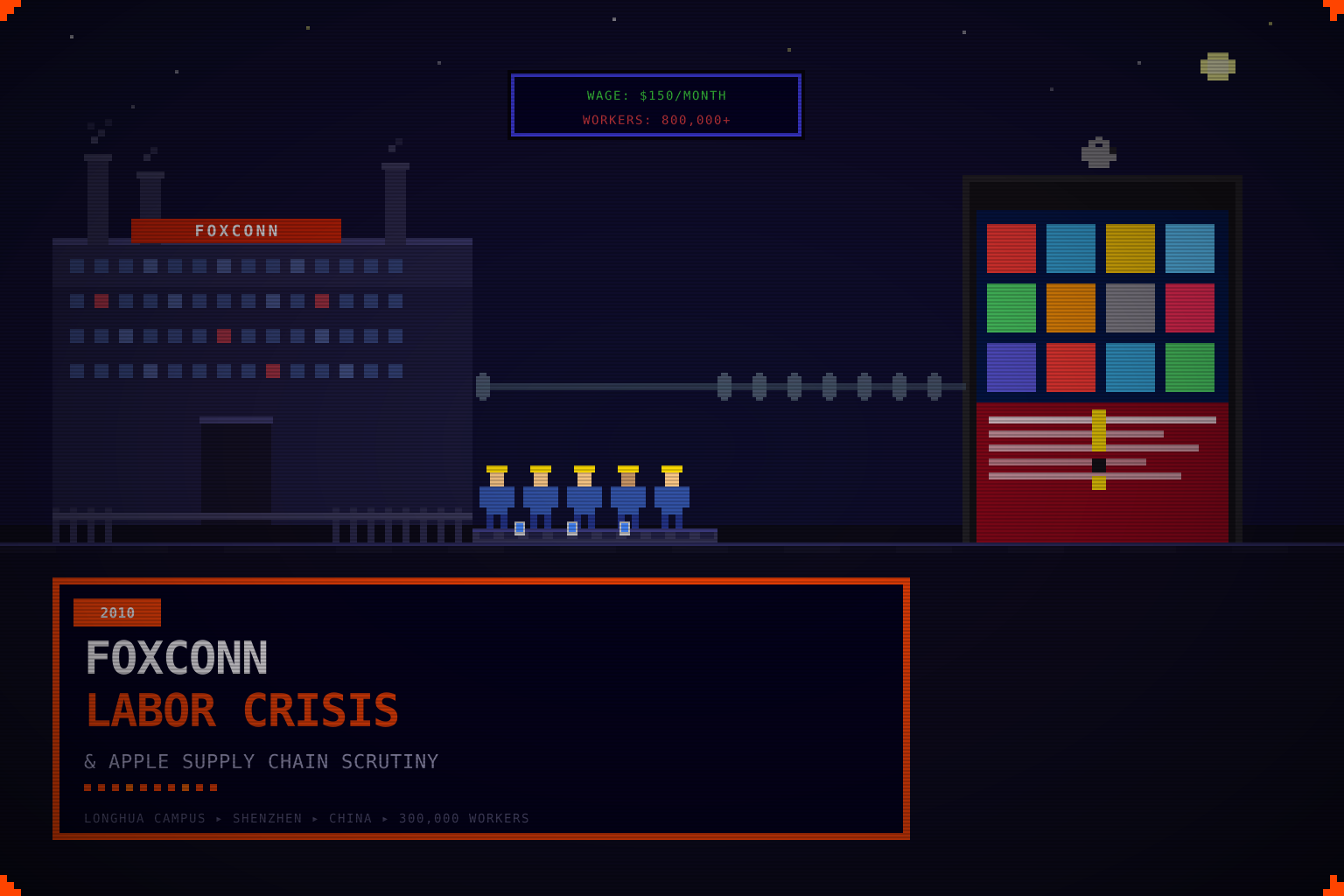
Key figures: Steve Jobs (Apple CEO, defending Foxconn); Terry Gou (Foxconn founder and CEO); Jenny Chan (Hong Kong-based labor researcher, author of Dying for an iPhone); Tian Yu (17-year-old survivor); Mike Daisey (American journalist whose dramatization amplified the crisis)
Background
Foxconn Technology Group, founded in 1974 by Terry Gou in Taiwan, had by 2010 become the world’s largest contract electronics manufacturer—employing over 800,000 workers in China alone, with its Longhua Science & Technology Park in Shenzhen operating as a self-contained city housing, feeding, and employing over 300,000 workers on one campus. The company assembled products for Apple, HP, Dell, Nintendo, Sony, and Nokia, but Apple’s explosive growth after the 2007 iPhone launch had made it Foxconn’s most critical client. Between 2007 and 2010, Apple’s iPhone and iPad lines drove an estimated 40 percent of Foxconn’s Shenzhen assembly lines, creating extreme production pressure. The iPad launched on April 3, 2010—a device that required entirely new assembly lines to be built out at Longhua in a matter of months—just weeks before the suicide crisis reached its peak in May 2010. China’s National Bureau of Statistics reported that manufacturing wages in coastal Guangdong Province averaged $150–180/month in 2009–2010, reflecting an era when China’s competitive advantage in global manufacturing rested substantially on suppressed labor costs.
Summary
In 2010, Foxconn Technology Group—the Taiwanese manufacturing giant assembling iPhones, iPads, and other consumer electronics—faced an unprecedented public relations catastrophe when eighteen of its Chinese employees either died by suicide or attempted it between January and November. Most victims were young (late teens to early twenties), many having worked at Foxconn for less than a year. The suicides occurred against a backdrop of severe labor practices: 12-hour workdays starting at 7:40 a.m., unpaid mandatory pre-shift meetings, forbidden conversation in workshops, arbitrary quota increases, and poverty wages (~$150/month). Despite Apple’s massive profitability (39.3% operating margins on iPhone), Foxconn’s margins were declining toward 1.5%—revealing a structural imbalance in which worker productivity funded shareholder returns rather than improved conditions. Steve Jobs initially downplayed concerns, describing Foxconn—with its restaurants, swimming pools, and other on-campus amenities—as one of the better facilities of its kind rather than a sweatshop. The crisis nonetheless sparked global scrutiny of electronics supply chains and became a watershed moment for corporate accountability in manufacturing, setting the stage for a decade of supply-chain ethics debates.
Key Facts
- Timeline: Between January 2010 and November 2010, eighteen Foxconn employees either died by suicide or survived suicide attempts, primarily at the Longhua campus in Shenzhen. The most intense cluster—ten deaths—occurred between March and May 2010.
- Demographics: Most victims were teenagers or in their early twenties; many had worked at Foxconn for less than one year, having migrated from rural provinces to Shenzhen for factory work.
- Notable survivor: Tian Yu, a 17-year-old worker from Hubei Province, survived a fall from a dormitory window on March 17, 2010, but was left permanently paralyzed from the waist down. Her case drew sustained media attention; she later became a symbol of the crisis.
- First victim: Ma Xiangqian, 19, died January 23, 2010; he had been transferred to a department where he was publicly humiliated after missing a production quota and reportedly worked 286 hours in the preceding month.
- Working conditions documented by researchers:
- 12-hour workdays beginning at 7:40 a.m., six days per week during peak production
- Unpaid mandatory pre-shift “stand-at-attention” meetings
- “Conversation in the workshop was forbidden”—workers faced discipline for speaking, working in silence for up to 12 hours
- Arbitrary quota increases: whenever workers consistently met targets, production quotas were raised, ensuring perpetual underperformance stress
- Public humiliation and written “confessions” for underperformance, witnessed by coworkers
- Standardized movements tracked by industrial engineers (Taylorist management at extreme scale)
- Monthly wages: approximately RMB 900–1,000 (~US$150) before overtime, below Shenzhen’s minimum wage in some reports
- Foxconn’s response (May–June 2010):
- Erected safety nets around dormitory buildings (May 2010); the installation of nets became a widely distributed visual symbol of the crisis
- Announced a 33 percent base-wage increase effective June 1, 2010 (from ~RMB 900 to ~RMB 1,200/month)
- Established 24-hour on-campus counseling centers and crisis hotlines
- Added psychological screening to the hiring process
- Required new hires to sign an anti-suicide pledge waiving liability claims against the company if they took their own lives—the pledge was retracted within days after global media condemnation
- Apple’s public stance: Steve Jobs, asked at a technology conference on June 1, 2010, dismissed conditions by saying Foxconn “has restaurants and movie theaters and hospitals and swimming pools, and I think they’re one of the better ones.” He confirmed Apple was investigating but offered no commitments to structural change.
- Financial disparity: Apple’s operating margin on iPhone reached 39.3 percent in fiscal 2010; Foxconn’s net margin was approximately 1.5–2 percent, compressing toward break-even while iPad and iPhone volumes surged. The iPhone 4, launched June 24, 2010, created another surge in assembly demand immediately after the crisis peak.
- Academic documentation: Researcher Jenny Chan and colleagues at Hong Kong Polytechnic University conducted on-the-ground interviews with 1,736 Foxconn workers beginning in 2009, producing the first systematic academic account of conditions; their 2020 book Dying for an iPhone synthesized a decade of findings.
Corporate Response Timeline
| Date | Event |
|---|---|
| January 23, 2010 | First death (Ma Xiangqian, 19); Foxconn makes no public statement |
| March 17, 2010 | Tian Yu, 17, falls from dormitory; left paralyzed; media coverage begins in Chinese press |
| April 3, 2010 | iPad launches; Foxconn’s Longhua facility under extreme ramp-up pressure |
| May 2010 | International media covers the cluster of deaths; Foxconn installs safety nets |
| May 26, 2010 | Al Jazeera and international outlets break the story to global audiences |
| June 1, 2010 | Steve Jobs dismisses concerns at D8 conference |
| June 1, 2010 | Foxconn announces 33% wage increase, effective immediately |
| June 24, 2010 | iPhone 4 launches; Foxconn production pressure remains high |
| Late 2010 | Apple’s Supplier Responsibility report pledges increased audit frequency |
| 2011 | Fair Labor Association begins auditing Foxconn facilities at Apple’s request |
Significance
The Foxconn labor crisis of 2010 catalyzed a global reckoning with consumer electronics supply chains and marked three decisive shifts:
-
Supply-chain ethics became a corporate liability: The crisis demonstrated that even the most profitable tech companies faced reputational damage when manufacturing partners exploited workers. The visual of safety nets strung around dormitory blocks became an indelible global image. By 2011, “ethical sourcing” and “fair labor” had moved from niche activist concerns to mainstream corporate-image issues for every consumer-electronics brand.
-
Wealth redistribution in globalized manufacturing: The dramatic margin gap (Apple 39.3% vs. Foxconn ~1.5%) exposed how globalization had restructured labor economics: Western tech companies captured value through design, software, and branding, while Asian manufacturers absorbed labor costs, production risk, and the human consequences of on-demand scaling. The Foxconn crisis provided the starkest data point yet for what critics called “supply chain capitalism.”
-
The beginning of enforced supply-chain accountability: The 2010 crisis preceded a decade of supply-chain audits, worker-rights litigation, and regulatory pressure. Apple’s Supplier Responsibility program—today covering hundreds of facilities across dozens of countries—traces its current scope directly to pressure generated by the 2010 crisis. The U.S. Dodd-Frank Act (signed July 21, 2010) included a “conflict minerals” provision partly inspired by supply-chain accountability arguments energized by the Foxconn coverage. China’s own minimum wage standards were raised substantially across multiple provinces in the years following 2010.
The crisis also highlighted a structural vulnerability: rapid consumer technology launches create unpredictable surges in manufacturing demand that are absorbed entirely by contract manufacturers and their workers, with no corresponding surge in wages or conditions. The iPad’s April 2010 launch—requiring Foxconn to build entirely new assembly lines in weeks—preceded the May suicide cluster by a matter of days.
Sources
- What Happened After the Foxconn Suicides (CBS News) — Detailed reporting on the 2010 suicides, working conditions, and Apple’s response.
- Alarm Over Apple Factory Suicides (Al Jazeera, May 2010) — Contemporary news coverage of the crisis as it unfolded in May 2010.
- Foxconn Suicides Spark Apple Probe (Cult of Mac) — Historical retrospective on the crisis and Apple’s response.
- Foxconn (Wikipedia) — Company overview including labor practices, the 2010 crisis, and subsequent reforms.
Related
- Steve Jobs’ 2010 Leadership and Apple’s Product Renaissance — Jobs’ leadership during the product boom—iPhone 4, iPad—that drove the Foxconn production surge underlying the crisis.
- iPad Launch (April 2010) — The iPad’s emergency ramp-up at Longhua preceded the May 2010 suicide cluster by days.
- iPhone 4 Launch (June 2010) — iPhone 4 production demands kept pressure high at Foxconn through 2010.
- Toyota Recall Crisis (January 2010) — Concurrent corporate-accountability crisis in manufacturing; both cases raised questions about the ethics of global production chains.
- Dodd-Frank Act (July 2010) — Financial reform legislation signed the same year; its supply-chain provisions (conflict minerals) were energized by the same accountability debates.
- China Overtakes Japan as Second Largest Economy (2010) — Foxconn’s labor practices reflected the broader structure of China’s export-manufacturing economy during its peak ascent.