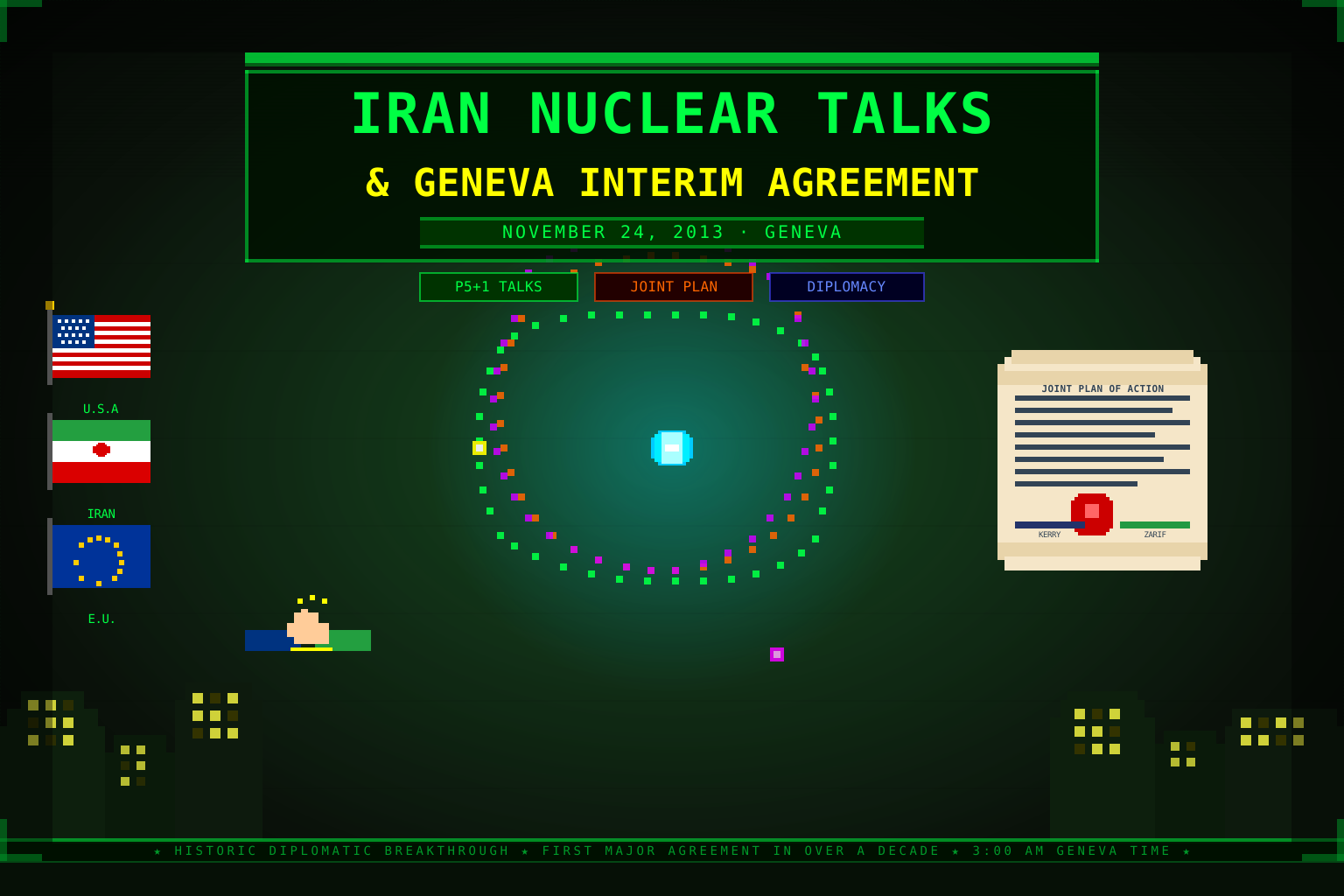
Key figures: John Kerry (U.S. Secretary of State), Javad Zarif (Iranian Foreign Minister), Catherine Ashton (EU High Representative for Foreign Affairs), Wendy Sherman (U.S. chief negotiator), Abbas Araghchi (Iranian deputy negotiator), Barack Obama (U.S. President), Hassan Rouhani (Iranian President), Benjamin Netanyahu (Israeli Prime Minister)
Summary
On November 24, 2013, Iran and the P5+1 (China, France, Germany, Russia, the United Kingdom, and the United States, coordinated through the European Union) signed a historic interim nuclear agreement in Geneva after four days of intensive negotiations. The agreement, formally titled the Joint Plan of Action (JPOA), marked the first major diplomatic breakthrough in negotiations over Iran’s nuclear program in over a decade and represented a significant de-escalation after years of international tensions and threats of military intervention.
The accord was announced at 3:00 a.m. Geneva time, following an all-night negotiating session. U.S. Secretary of State John Kerry stood beside EU High Representative Catherine Ashton and Foreign Ministers of the five other world powers to announce the agreement, joined by Iranian Foreign Minister Javad Zarif in what observers described as an atmosphere of controlled relief. U.S. President Barack Obama spoke to reporters from the White House at approximately 11:30 p.m. Eastern time (November 23) immediately after the signing, calling it “an important first step toward a comprehensive solution.”
Road to Geneva: The 2013 Diplomatic Thaw
The Rouhani Election
The immediate precondition for the Geneva agreement was the June 14, 2013, election of Hassan Rouhani as President of Iran. Rouhani, a centrist cleric who had previously served as Iran’s chief nuclear negotiator between 2003 and 2005, ran on a platform of “heroic flexibility”—a phrase he borrowed from Ayatollah Khomeini and intended to signal a willingness to make pragmatic concessions while preserving core Iranian principles. He defeated five other candidates in the first round with 50.7% of the vote.
Rouhani’s election was widely read in Western capitals as a signal that Supreme Leader Ali Khamenei had authorized a nuclear diplomacy initiative, since no Iranian presidential candidate could pursue foreign-policy positions contrary to the Supreme Leader’s preferences. Khamenei subsequently endorsed the diplomatic approach, publicly calling for “heroic flexibility” on nuclear talks.
The Obama–Rouhani Phone Call
On September 27, 2013—the day Rouhani was departing New York after addressing the United Nations General Assembly—President Obama called him on a cell phone. The 15-minute call was the first direct contact between an American and Iranian head of state since the 1979 Islamic Revolution, breaking a 34-year taboo. Obama had reached out through diplomatic intermediaries, and Rouhani had secured approval from Khamenei before accepting the call.
The call did not immediately produce diplomatic results—Rouhani faced conservative criticism in Iran for even speaking with Obama—but it signaled that serious negotiations were possible and accelerated the track toward Geneva.
The Oman Back-Channel
Behind the visible diplomatic process, a sustained secret back-channel between U.S. and Iranian officials had been developing since at least early 2013, facilitated by the Sultan of Oman Qaboos bin Said. The secret U.S. delegation was led by Deputy Secretary of State William J. Burns, joined by Jake Sullivan—then the State Department’s director of policy planning and national security adviser to Vice President Joe Biden—who made repeated covert visits to Oman for direct talks with Iranian counterparts. These back-channel meetings allowed both sides to test positions, build trust, and identify the outlines of a possible deal before the public multilateral negotiations in Geneva began. When the back-channel’s existence was later reported by the Associated Press in November 2013, it revealed the depth of the diplomatic preparation that had made the Geneva agreement possible.
Key Provisions of the Agreement
Iran’s Commitments
- Halt enrichment above 5%: Iran agreed to cease further enrichment of uranium beyond the 5% purity needed for civilian nuclear reactors, and to halt installation of additional centrifuges.
- Dilute the 20% stockpile: Iran committed to diluting approximately half of its existing 196-kilogram stockpile of uranium enriched to 20% purity to 3.5% or lower, removing a potential near-weapons-grade material from accessible inventory. The remaining half was to be converted to oxide form unusable for further enrichment without additional processing.
- Suspend Arak reactor work: Iran agreed to halt construction and testing of the IR-40 heavy-water reactor at Arak, a facility that once operational would produce plutonium as a byproduct—providing an alternative fissile pathway to weapons-grade material. Iran agreed not to transfer fuel or heavy water to Arak during the interim period.
- Expanded IAEA access: Iran agreed to allow the International Atomic Energy Agency daily access to monitoring equipment at the Natanz and Fordow enrichment facilities, and to provide detailed information on construction of new nuclear facilities, centrifuge production, and uranium mines. This represented the most intrusive inspection regime Iran had accepted to that date.
P5+1 Reciprocal Measures
- $7 billion in targeted sanctions relief: The world powers agreed to provide approximately $7 billion in limited, reversible sanctions relief to Iran—$4.2 billion of which consisted of releasing frozen Iranian petroleum revenues held in restricted foreign bank accounts, released in monthly tranches. Additional relief covered petrochemical exports, gold and precious metals trade, auto parts, and civil aviation spare parts.
- No new nuclear sanctions: The P5+1 committed to refraining from imposing additional nuclear-related sanctions on Iran during the six-month period, though existing sanctions remained in place.
- U.S. commitments on food and medicine: The United States committed to facilitating transactions for Iranian humanitarian goods that had been disrupted by sanctions, including food and medicine purchases.
The $7 billion figure was disputed: the U.S. administration characterized most of it as unlocking frozen Iranian assets rather than providing new economic benefits, while Iranian officials publicized the higher total figure. Independent analysts generally judged the net economic value to Iran to be well below the headline $7 billion, since most of the relief unlocked assets Iran already owned rather than delivering new revenue.
Diplomatic Significance
The Context of Syrian Crisis
The Geneva agreement emerged against a backdrop shaped by the Syria chemical weapons crisis earlier in 2013. The August 21 Ghouta attack and the subsequent September 14 U.S.–Russia framework for Syrian chemical weapons disarmament had demonstrated that the Obama administration was willing to pursue negotiated solutions to WMD crises rather than automatic military responses—a signal that influenced Iranian calculations about the viability of a nuclear deal.
The NSA Revelations Context
The diplomatic environment of 2013 was also complicated by the global fallout from Edward Snowden’s NSA revelations, which had created friction between the United States and numerous allies and raised international concerns about U.S. intelligence activities. While the NSA controversy did not directly affect the nuclear talks, it complicated the Obama administration’s diplomatic capital with key allies in the P5+1 coalition during the same period.
The U.S. Government Shutdown Contrast
The Geneva success came weeks after the U.S. government shutdown of October 1–16, 2013—a period that had prevented Secretary Kerry from attending an early round of talks and forced the United States to delay diplomatic engagements. The contrast between domestic political dysfunction and international diplomatic achievement characterized the Obama administration’s foreign policy posture in late 2013.
Scope and Duration
The Joint Plan of Action was explicitly designed as a temporary, six-month interim agreement with built-in extension provisions. Its text stated clearly that neither side was prejudging the ultimate resolution of the nuclear question. Iran maintained its position that it had an “inalienable right” to uranium enrichment; the United States and some European partners declined to explicitly acknowledge that right in the interim agreement text, leaving the issue unresolved for the comprehensive negotiations to follow.
Implementation and Aftermath
The agreement was formally activated on January 20, 2014, when implementation began and the IAEA confirmed Iran’s compliance with initial steps. The six-month interim period was subsequently extended twice—in July 2014 and November 2014—while negotiations on a comprehensive agreement continued.
These extensions ultimately bridged the gap to the Joint Comprehensive Plan of Action (JCPOA), finalized in Vienna on July 14, 2015 (announced on July 14, implementation day designated as January 16, 2016). The JCPOA was far more comprehensive than the JPOA, extending Iran’s enrichment breakout timeline to at least one year for a period of ten to fifteen years and subjecting Iran’s nuclear program to the most extensive monitoring regime ever negotiated for a non-weapons state.
Reactions and Controversy
Israel: Prime Minister Benjamin Netanyahu called the Geneva agreement a “historic mistake” in a November 24 statement, arguing that Iran had achieved sanctions relief while retaining its nuclear infrastructure intact. Netanyahu urged Israel’s allies to refuse to sign any agreement short of full dismantlement of Iran’s enrichment capability. The Israeli government’s rejection of the deal created significant friction with the Obama administration and highlighted a growing strategic divergence between the two governments on Iran policy.
U.S. Congress: A bipartisan group of senators, including Robert Menendez (Democrat, New Jersey) and Mark Kirk (Republican, Illinois), immediately introduced legislation for additional sanctions on Iran, threatening to collapse the diplomatic process. The Obama administration lobbied intensively against the bill, and Senate Majority Leader Harry Reid declined to schedule a vote during the interim period.
Iran’s hardliners: Conservative members of Iran’s parliament and the Revolutionary Guard expressed skepticism about the agreement, with some clerics calling the concessions on enrichment an unacceptable compromise on national sovereignty. Rouhani and Zarif defended the agreement as having secured international recognition of Iran’s enrichment activities while providing economic relief.
Russia and China: Both welcomed the agreement as a validation of multilateral diplomacy and as an alternative to the military escalation they had consistently opposed. Russia’s role as a P5+1 member in 2013 came during a period of deteriorating U.S.–Russia relations—the same diplomatic period that produced the Snowden asylum controversy—making Moscow’s cooperation on the Iran deal a notable instance of continued major-power cooperation despite bilateral tensions.
Significance
The Geneva Interim Agreement of November 24, 2013, marked a watershed in contemporary nuclear nonproliferation diplomacy. It demonstrated that sustained, multilateral engagement—including secret back-channel preparation and the willingness to offer tangible economic concessions—could produce breakthroughs on issues thought intractable after decades of confrontation.
The agreement averted an immediate military escalation that had appeared increasingly likely in 2012–2013, when Israeli officials had publicly suggested unilateral military strikes on Iranian nuclear facilities might be necessary. It established a precedent for negotiated solutions to nuclear disputes that influenced subsequent diplomacy involving North Korea and other states with contested nuclear programs.
The agreement also illustrated the importance of domestic political conditions—in both the United States and Iran—in enabling or preventing diplomatic progress. Rouhani’s election, Khamenei’s authorization, and Obama’s willingness to offer sanctions relief despite Congressional opposition all proved necessary conditions for the November 2013 breakthrough.
Sources
- Joint Plan of Action (Iran nuclear talks) — Wikipedia
- Iran nuclear talks — Timeline — Arms Control Association
- Joint Comprehensive Plan of Action — Wikipedia
- Obama–Rouhani phone call — Wikipedia
- Iran–Oman back-channel talks — Associated Press reporting
- Iran and world powers reach nuclear deal in Geneva — The Times of Israel
- CRS Report: Iran Nuclear Negotiations — Congressional Research Service