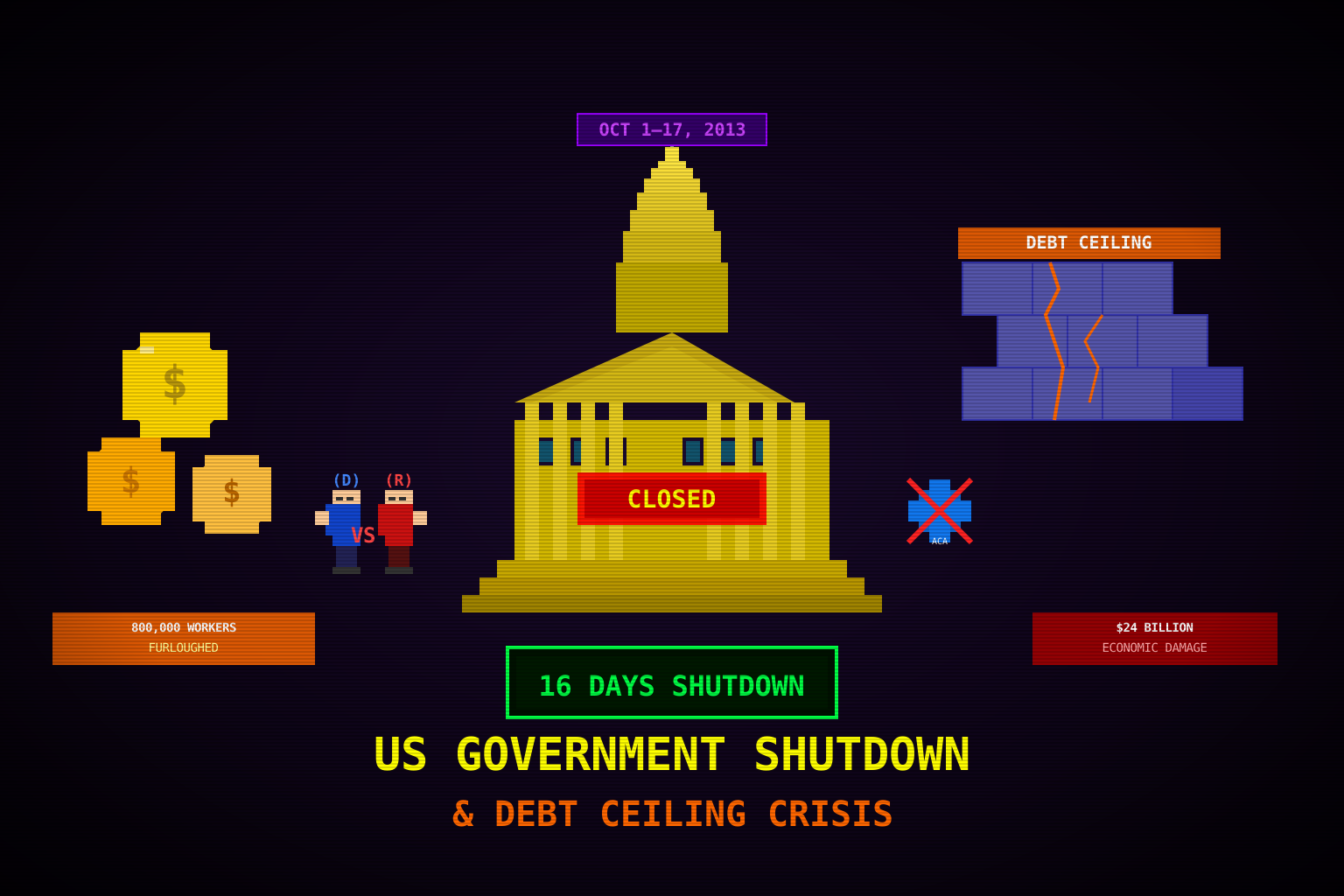
Key figures: House Speaker John Boehner (R-Ohio); Senate Majority Leader Harry Reid (D-Nevada); President Barack Obama; Sen. Ted Cruz (R-Texas); OMB Director Sylvia Mathews Burwell
Summary
On October 1, 2013, the United States federal government entered a shutdown when neither legislation appropriating funds for fiscal year 2014 nor a continuing resolution authorizing interim operations was enacted before the midnight deadline. The shutdown lasted 16 days—until October 17, 2013—and became the fifth-longest in American history. It furloughed approximately 800,000 federal employees, required 1.3 million more to work without immediate pay, and generated an estimated $24 billion in economic damage according to Standard & Poor’s, with the Government Accountability Office’s narrower direct-cost estimate reaching approximately $2 billion in back pay to furloughed workers alone and roughly $5 billion in total direct budgetary costs.
The impasse centered on conflicting demands between the Republican-controlled House of Representatives and the Democratic-controlled Senate. House Republicans, led by Speaker John Boehner (R-Ohio) and influenced by a Tea Party-aligned faction, demanded policy concessions in exchange for approving budget legislation: primarily, they sought to defund or delay the Affordable Care Act (ACA, commonly known as “Obamacare”) and implement specific spending cuts. The Democratic-controlled Senate and President Barack Obama refused to negotiate healthcare reform as a condition of routine appropriations, insisting that Congress should fund the government and raise the debt ceiling without ideological preconditions.
Cruz Filibuster and the Tea Party Strategy
The immediate trigger for the shutdown standoff was an escalation strategy orchestrated primarily by Sen. Ted Cruz (R-Texas), elected to the Senate in 2012 on a Tea Party wave, and supported by the Heritage Foundation’s political affiliate, Heritage Action, which had issued a memo to House Republicans in August 2013 urging them to oppose any continuing resolution that funded the ACA.
On September 24, 2013, Cruz began a marathon speech on the Senate floor opposing ACA funding that lasted 21 hours and 19 minutes—ending at noon on September 25, 2013. The speech did not constitute a formal filibuster under Senate rules (the Senate had already agreed to allow a vote to proceed, and Cruz’s speech could not delay that vote), but it became one of the longest continuous floor speeches in Senate history and generated substantial media attention. Cruz read passages from Green Eggs and Ham by Dr. Seuss during the speech, a detail widely mocked and amplified by news coverage. The speech mobilized the House Tea Party caucus—the House Freedom Caucus’s predecessor—and hardened resistance to any compromise.
The Tea Party strategy sought to exploit the September 30 funding deadline (the end of fiscal year 2013) as leverage to force a defunding or one-year delay of the ACA’s individual mandate and insurance exchanges, which were scheduled to open for enrollment on October 1, 2013—the same day the shutdown began. This timing was not coincidental: forcing a confrontation over government funding on the very day the ACA’s most visible provisions took effect was a deliberate political and symbolic choice.
Legislative Timeline
- August 2, 2013: Heritage Action memo urges House Republicans to oppose any CR funding the ACA.
- September 20, 2013: House passes CR (230–189) that defunds the ACA; 2 Republicans vote against it.
- September 24–25, 2013: Cruz’s 21-hour Senate floor speech.
- September 27, 2013: Senate passes a “clean” CR (54–44) by party-line vote, stripping ACA defunding language, and returns it to the House.
- September 28–29, 2013: House passes amended CR (228–201) adding a one-year ACA delay and repeal of the medical-device tax; Senate tables it (54–46).
- September 30, 2013, midnight: Government funding lapses. Shutdown begins at 12:01 AM October 1.
- October 1, 2013: ACA health-insurance exchanges open for enrollment despite the shutdown; Healthcare.gov experiences severe technical failures from day one.
- October 3, 2013: Capitol Hill car chase and shooting incident (an unrelated security event) underscores the disrupted operational environment in Washington during the shutdown.
- October 12–14, 2013: Senate negotiators Susan Collins (R-Maine) and Joe Manchin (D-W.Va.) broker a bipartisan framework; it stalls in the House.
- October 16, 2013: Senate passes the Continuing Appropriations Act, 2014 (81–18); House passes it (285–144) later the same day.
- October 17, 2013: President Obama signs the act into law at 12:30 AM, ending the shutdown.
Effects and Economic Impact
During the 16 days of shutdown, federal services were disrupted across virtually every domestic agency:
- National parks and monuments: All 401 national park sites closed, affecting an estimated 715,000 daily visitors and costing tourism-dependent communities near parks tens of millions of dollars.
- Public health: The Centers for Disease Control and Prevention furloughed approximately 68% of its staff, temporarily suspending epidemiological surveillance programs. The National Institutes of Health stopped admitting new clinical-trial patients, turning away approximately 200 people per week who had no other treatment options.
- Food safety: The Food and Drug Administration suspended approximately 90% of routine food-safety inspections and halted import screening of imported seafood, produce, and other food products.
- Veterans benefits: VA benefit processing slowed; approximately 3.6 million disability claim decisions were delayed.
- Mortgage and housing: FHA (Federal Housing Administration) loan applications slowed significantly, delaying thousands of home-purchase closings.
- Small Business Administration: SBA suspended loan guarantees, affecting small businesses nationwide.
- Head Start: More than 6,300 children lost early-education spots when federal grants were not disbursed to Head Start programs in 11 states.
The overall economic impact was substantial. Standard & Poor’s estimated the shutdown removed $24 billion from the US economy and reduced fourth-quarter 2013 GDP growth by 0.6 percentage points. The federal government also incurred estimated back-pay liability of approximately $2 billion for furloughed employees who were compensated for the shutdown period despite not working—a cost mandated by Congress’s retroactive pay authorization passed as part of the reopening legislation.
The Debt Ceiling Standoff
Simultaneous with the shutdown, the United States Treasury Department issued increasingly urgent warnings that the government would exhaust its borrowing authority under the statutory debt ceiling by approximately October 17, 2013. Treasury Secretary Jack Lew informed Congress on October 1 that the government had fewer than $30 billion in extraordinary measures available—insufficient to meet obligations beyond mid-October. An American default on its debt obligations was universally described by economists, financial institutions, and foreign governments as potentially catastrophic: it would likely trigger a global financial panic, raise US borrowing costs permanently, and threaten the dollar’s status as the world’s primary reserve currency.
The debt ceiling had been suspended from February 4 to May 18, 2013, then reinstated at the debt level accumulated during the suspension—approximately $16.7 trillion. Throughout the shutdown, the Treasury employed “extraordinary measures” to avoid breaching the ceiling, but those measures approached exhaustion. JPMorgan Chase, Fitch Ratings, and the International Monetary Fund all issued warnings about default risk during the shutdown period.
The dual crisis—shutdown plus default risk—gave Democrats significant leverage. Polling consistently showed (Gallup, Pew Research, NBC News/Wall Street Journal polls) that a majority of Americans blamed Republican members of Congress rather than the President or Democratic lawmakers for the shutdown, with blame assigned to House Republicans in most surveys by margins of 10–22 percentage points.
Resolution and Political Aftermath
On October 16, 2013, after 16 days of escalating pressure, House Republicans abandoned their demands without obtaining any of the policy concessions they had sought. The Continuing Appropriations Act, 2014 funded the government through January 15, 2014, and suspended the debt ceiling through February 7, 2014. The ACA remained fully funded and in effect. President Obama signed the bill at 12:30 AM on October 17, just hours before the Treasury Department’s projected default deadline.
The political consequences were swift and severe for Republicans. The House GOP’s approval rating fell to 24% in October 2013 Gallup polling, the lowest recorded for either party in Congress since Gallup began tracking the question. Speaker Boehner’s own standing within his conference was weakened: he had ultimately passed the clean continuing resolution with 87 Republican votes supplemented by 198 Democratic votes, effectively bypassing the House Tea Party caucus—a political risk he had been reluctant to take for the previous three years.
Ted Cruz, despite engineering the confrontation, emerged with enhanced standing among the Tea Party base while becoming a figure of controversy within the Senate Republican caucus. Sen. John McCain publicly called the strategy “suicide” and “a fool’s errand.” In the longer term, the episode contributed to the political dynamics that would shape the 2014 midterm elections and the subsequent Tea Party-aligned House Freedom Caucus’s formation in January 2015.
The shutdown also ironically obscured the disastrous rollout of Healthcare.gov, the ACA’s federal insurance marketplace website. The site’s catastrophic technical failures—it crashed repeatedly on opening day, October 1, 2013, due to inadequate capacity planning and poor contractor management—might have dominated political coverage for weeks, but the shutdown crowded it out of the news cycle during the critical early enrollment period.
Significance
The October 2013 government shutdown marked a turning point in American political culture and congressional governance. It demonstrated the willingness of a significant faction within the House Republican Conference to use a government shutdown and default threat as leverage for ideological policy demands—tactics without precedent in the prior history of appropriations disputes. The episode revealed deep structural changes in Congress: the failure to pass regular appropriations bills (Congress had not passed a comprehensive omnibus appropriations bill by regular order since fiscal year 2009), the rise of ideological purity demands within the House GOP, and the erosion of norms around bipartisan budget negotiation.
For context on the national security environment that the shutdown disrupted, see Syria’s Chemical Weapons Disarmament Agreement, which was being implemented during the same period, as well as Snowden NSA Revelations, which had created the broader atmosphere of institutional tension and executive-legislative mistrust that shaped the 2013 political environment.
For the remainder of the Obama administration and through subsequent presidencies, the threat of shutdown became a recurring feature of political negotiations, and the debt ceiling repeatedly became a tool for brinkmanship rather than routine fiscal management. The 2013 shutdown thus marks a transformation in how American government manages its basic budgetary obligations—from routine administrative process to high-stakes political confrontation.
Sources
- 2013 United States federal government shutdown — Wikipedia
- 2013 United States debt-ceiling crisis — Wikipedia
- 2013 Government Shutdown: Three Departments Reported Varying Degrees of Impacts on Operations, Grants, and Contracts — U.S. GAO
- Economic Studies Experts On the Government Shutdown and Debt Ceiling Standoff — Brookings Institution
- Government Shutdown: The Economic Impact — Standard & Poor’s
- Ted Cruz’s 21-Hour Senate Speech — C-SPAN Archives