Overview
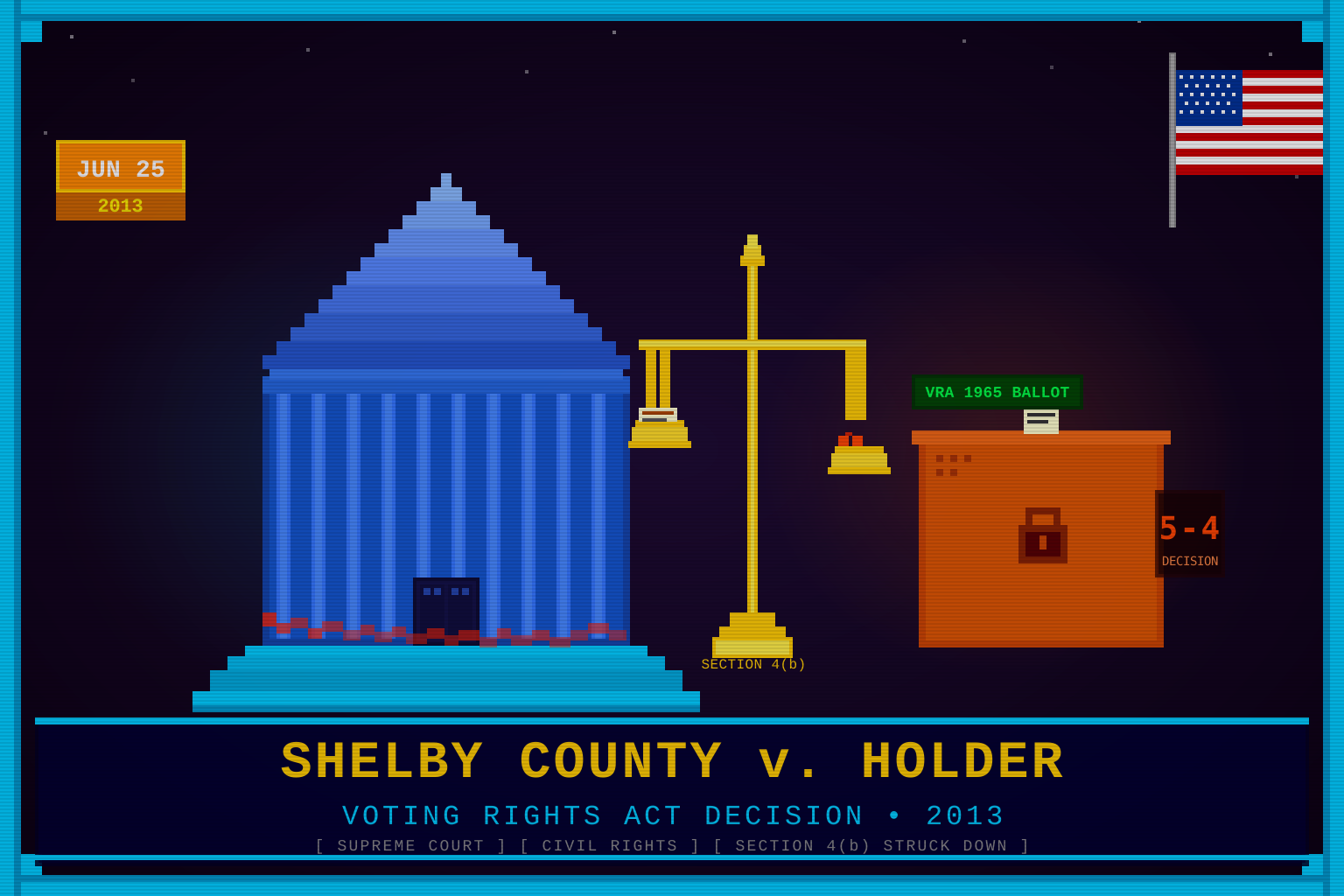
On June 25, 2013, the U.S. Supreme Court issued a landmark 5-4 decision in Shelby County v. Holder, striking down the coverage formula in Section 4(b) of the Voting Rights Act of 1965. The case centered on whether the preclearance requirement—which obligated certain jurisdictions with histories of racial discrimination to obtain federal approval before implementing voting-law changes—remained constitutional nearly five decades after the Act’s passage.
Background: The Voting Rights Act
President Lyndon B. Johnson signed the Voting Rights Act into law on August 6, 1965, following the violent suppression of the Selma-to-Montgomery marches and mounting congressional pressure. The Act was Congress’s response to systematic disenfranchisement of Black voters in southern states, enforced through literacy tests, poll taxes, intimidation, and outright violence at polling places.
Section 5 of the Act required that certain “covered” jurisdictions—identified by the Section 4(b) coverage formula—obtain federal “preclearance” before any change to voting laws could take effect. A jurisdiction was covered if it had maintained a voting test or device as of November 1, 1964, and had less than 50 percent voter registration or turnout in the 1964 presidential election. The formula originally covered Alabama, Georgia, Louisiana, Mississippi, South Carolina, Virginia, and parts of North Carolina.
Congress reauthorized the Voting Rights Act four times—in 1970, 1975, 1982, and 2006. The 2006 reauthorization, known as the Fannie Lou Hamer, Rosa Parks, and Coretta Scott King Voting Rights Act Reauthorization and Amendments Act, passed by a vote of 390–33 in the House and 98–0 in the Senate, and was signed by President George W. Bush. Congress at the time compiled a record of approximately 15,000 pages of evidence documenting ongoing voting discrimination in covered jurisdictions.
The Case and Legal Question
Shelby County, Alabama challenged the constitutionality of the Voting Rights Act’s coverage formula. The county’s population of approximately 212,000 sits in the Birmingham metropolitan area and had been subject to preclearance since the Act’s passage. Shelby County argued that Section 4(b)’s formula—still rooted in voter registration and turnout data from the 1960s, updated only partially in 1975—had become an anachronistic measure of discrimination that no longer reflected current electoral realities.
Chief Justice John G. Roberts, Jr., writing for the majority joined by Justices Scalia, Kennedy, Thomas, and Alito, reasoned that racial disparities in voter registration and turnout had substantially declined since 1965, and that minority turnout had in several states exceeded turnout in previously uncovered jurisdictions. The majority invoked the principle of “equal sovereignty” among the states, arguing that the different treatment of states under the coverage formula was constitutionally suspect and required a contemporary justification that Congress had not provided.
The Ruling
The Court held that Section 4(b)—the coverage formula—was unconstitutional. The majority did not strike down Section 5 itself or find that preclearance was inherently impermissible, but determined that without a valid, updated formula, Section 5 had no coverage mechanism and was therefore unenforceable.
Justices Ruth Bader Ginsburg, Sonia Sotomayor, Elena Kagan, and Stephen Breyer dissented. Justice Ginsburg’s dissent, the most extensive, argued that the majority’s logic resembled “throwing away your umbrella in a rainstorm because you are not getting wet.” The dissenters emphasized that the preclearance mechanism had been precisely the reason discrimination rates had declined—it was working as intended—and that Congress had comprehensively reviewed 15,000 pages of evidence before the 2006 reauthorization. The dissent noted that between 1982 and 2006, Department of Justice objections had blocked more than 700 discriminatory voting changes in covered jurisdictions.
Immediate Aftermath
The decision’s consequences materialized within hours. On June 25, 2013—the same day the ruling was handed down—Texas Attorney General Greg Abbott announced the state would immediately implement Senate Bill 14, a strict photo identification law that had been blocked by the Justice Department under preclearance review. On June 26, North Carolina’s legislature announced plans for House Bill 589, an omnibus voting-restrictions measure that would ultimately combine a strict photo ID requirement with a reduction in early-voting days from 17 to 10, elimination of same-day registration, and restrictions on out-of-precinct provisional voting.
Alabama and Mississippi announced plans to move forward with their own photo ID laws within days of the ruling.
State-Level Voting Restrictions
The years following the decision saw a documented surge in voting restrictions in formerly covered and newly uncovered jurisdictions alike. The Brennan Center for Justice found that between 2011 and 2016, 23 states enacted new voting restrictions of some kind. A 2018 report by the Leadership Conference on Civil and Human Rights documented 868 polling-place closures in counties that had previously been subject to preclearance between 2012 and 2018.
Research published in the Journal of Politics found that formerly covered jurisdictions were significantly more likely to reduce polling locations and enact stricter voter identification requirements following the decision than comparable jurisdictions that had not been subject to preclearance.
Attempts to Restore Preclearance
Congress attempted to pass replacement legislation several times after Shelby County. The Voting Rights Amendment Act of 2014 proposed a new coverage formula based on recent voting discrimination violations rather than historical data, but it failed to advance through the Republican-controlled House. The John Lewis Voting Rights Advancement Act, introduced in subsequent Congresses and named after the civil rights leader who was beaten on the Edmund Pettus Bridge in 1965, passed the House in 2019 and again in 2021 but was blocked in the Senate. Section 5 preclearance remained dormant without a functioning coverage formula as of 2023.
Significance and Legacy
Shelby County v. Holder marked a watershed moment in voting-rights jurisprudence, shifting the burden of proof from covered jurisdictions—which had to show that voting changes would not harm minority voters—to civil-rights advocates and the Department of Justice, who now had to identify and prosecute discrimination in court after the fact. The Section 2 litigation pathway that remained was substantially more resource-intensive and slower than preclearance review.
The case intersected with broader 2013 debates about race, law, and equality. Just weeks after the ruling, a Florida jury acquitted George Zimmerman in the shooting death of Trayvon Martin (see George Zimmerman Acquittal), further intensifying national conversations about institutional protections for racial minorities. Meanwhile, revelations about NSA surveillance published in June 2013 (see Snowden NSA Revelations) underscored contemporaneous debates about federal power, civil liberties, and constitutional interpretation. The subsequent October government shutdown further reflected the political polarization shaping congressional inaction on voting-rights legislation.
Historians and legal scholars have characterized the decision as one of the most consequential Supreme Court rulings on race and democracy since Bush v. Gore (2000), with its effects continuing to shape electoral law, congressional debates, and civil rights litigation into the 2020s.
Sources
- Brennan Center for Justice: Shelby County v. Holder
- U.S. Department of Justice: Reflecting On the 10th Anniversary of Shelby County v. Holder
- NAACP Legal Defense Fund: Shelby County v. Holder
- Constitution Center: Shelby County v. Holder
- Rock the Vote: Shelby v. Holder Explainer
- Leadership Conference: Polling Place Closures Report