Overview
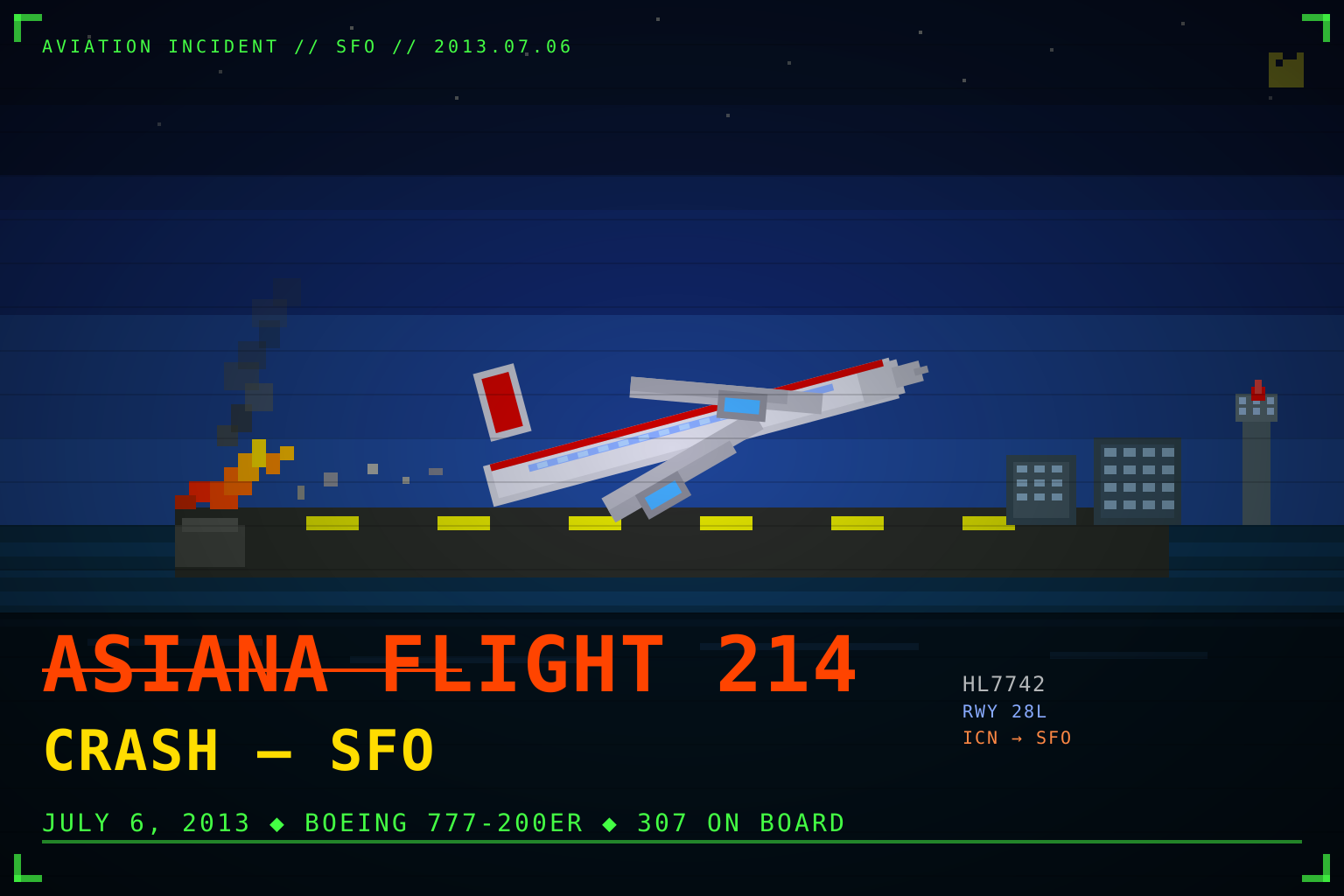
On July 6, 2013, Asiana Airlines Flight 214, a Boeing 777-200ER registered as HL7742, crashed during final approach to Runway 28L at San Francisco International Airport. The aircraft, operating a trans-Pacific flight from Seoul’s Incheon International Airport, struck a seawall just short of the runway threshold at approximately 11:28 AM local time, killing three people and injuring 187 others. The accident marked the first fatal crash of a Boeing 777 since the aircraft type entered commercial service on June 7, 1995—an 18-year safety record.
Flight Background
Flight 214 departed Seoul’s Incheon International Airport at 4:35 PM local time on July 5, 2013 (crossing the International Date Line, arriving July 6 in San Francisco). The aircraft, a Boeing 777-200ER that had been delivered to Asiana Airlines on March 12, 2006, carried 291 passengers and 16 crew members, totaling 307 people on board.
The flight crew consisted of Captain Lee Jung-min as the pilot in command (a check airman supervising training), First Officer Lee Gang-kuk as the flying pilot (receiving line training on the Boeing 777), and additional crew members in supporting roles. First Officer Lee had approximately 43 hours of flight time on the 777 type specifically, though his overall experience was considerably more extensive.
Approach and Impact
For Runway 28L at San Francisco International Airport, the Instrument Landing System (ILS) glideslope—the standard precision guidance aid that provides vertical guidance on approach—had been deactivated since June 1, 2013, due to construction activity at the airport. A Notice to Airmen (NOTAM) had been issued to all carriers. In clear, daylight conditions, the crew requested and received clearance for a visual approach, relying on visual cues rather than instrument guidance.
The Precision Approach Path Indicator (PAPI)—a set of lights beside Runway 28L that provides a visual glidepath reference—remained operational, and during the final approach it would have displayed an increasingly “all red” indication signaling that the aircraft was well below the correct glidepath. The NTSB found that the crew did not adequately monitor the PAPI, the airspeed, or the aircraft’s vertical path, relying instead on visual judgment and mismanaged automation for vertical-path control.
During final approach, the aircraft descended below the optimal 3-degree glide path. The flight data recorder indicated that airspeed fell to approximately 103 knots at impact—significantly below the required approach speed of approximately 137 knots for the aircraft’s weight and configuration. The crew initiated a go-around thrust command only 1.5 seconds before impact, too late for the engines to spool up to full power.
At 11:28 AM, the aircraft’s tail struck the seawall at the edge of the runway threshold. The impact severed the tail section, landing gear, and engines. The fuselage slid approximately 2,400 feet down the runway, rotating counterclockwise before coming to rest on the pavement. Emergency evacuation slides deployed, and the approximately 305 survivors began evacuating.
Casualties and Injuries
Three people were killed as a result of the accident:
- Ye Mengyuan, 16, a Chinese student, died at the scene from blunt-force injuries sustained during the crash.
- Wang Linjia, 16, also a Chinese student and Ye’s classmate, died at the scene.
- Liu Yipeng, 16, a third Chinese student, survived the initial crash but was struck and fatally injured by an Airport Fire Department vehicle during rescue operations and died on July 12, 2013.
An additional 187 of the 307 people aboard were injured; 49 sustained serious injuries requiring hospitalization. The relatively low fatality count given the severity of the crash was attributed to the aircraft’s structural integrity, the behavior of the cabin crew during evacuation (flight attendant Lee Yoon-hye was credited with helping organize the passenger evacuation despite sustaining a broken tailbone), and the rapid response of San Francisco International Airport’s emergency services.
Cause and Investigation
The National Transportation Safety Board (NTSB), chaired by Deborah Hersman, conducted the investigation. The NTSB released its final report on June 24, 2014, identifying the probable cause as pilot error compounded by automation management failures and training deficiencies.
Key contributing factors included:
Autothrottle and Autopilot Mismanagement: The crew had engaged the autopilot’s approach mode in a configuration that, under certain conditions, would not maintain minimum airspeed automatically. Boeing’s documentation did not clearly describe the interaction between the autopilot and autothrottle systems in the configuration the crew was using. The NTSB found Boeing’s documentation inadequate and Asiana’s training insufficient on this specific failure mode.
Inadequate Visual-Approach Training: First Officer Lee had not previously conducted a visual approach to San Francisco’s Runway 28L and had limited overall experience with visual approaches on the 777. Asiana’s training program did not emphasize manual flight and visual-approach procedures sufficiently.
Startle Response and Late Action: As the aircraft descended below glidepath and airspeed deteriorated, crew reaction was delayed. A stick-shaker (stall warning) activated 4 seconds before impact; the go-around command came 1.5 seconds before impact.
Crew Resource Management: The acting instructor pilot did not adequately intervene as the approach became unstable and the aircraft fell below stabilized-approach criteria.
The NTSB issued 29 safety recommendations to the FAA, Boeing, Asiana Airlines, and airport authorities. Asiana Airlines subsequently agreed to pay a $500,000 fine to the FAA for safety violations identified in the investigation’s wake, and separately entered into a $37.5 million settlement related to the crash’s legal aftermath.
Safety Impact and Industry Response
As the first fatal accident of a Boeing 777, the crash prompted a broad re-examination of assumptions about highly automated aircraft and pilot proficiency.
The FAA and international aviation authorities issued guidance on:
- Maintaining manual flight proficiency and visual-approach skills, particularly on long-haul routes dominated by autopilot operation
- Enhanced documentation requirements for complex autoflight system interactions
- Standardized policies for stabilized-approach criteria and mandatory go-around procedures
The accident reinforced debates about automation dependency in commercial aviation—a theme also addressed in the aftermath of the Air France Flight 447 crash (2009) and later the Boeing 737 MAX accidents (2018–2019). Aviation safety researchers cited Flight 214 as evidence that high-automation cockpit environments could erode pilots’ manual handling skills if airlines and regulators did not actively require proficiency maintenance.
San Francisco International Airport’s Runway 28L reopened on July 7, 2013, one day after the crash.
Context
Flight 214 was the most severe transportation disaster in the United States in 2013, occurring against a backdrop of other major disasters that year. The Rana Plaza building collapse in Bangladesh on April 24, 2013, had killed over 1,100 garment workers four months earlier, generating international scrutiny of industrial safety across global supply chains. Later that year, Typhoon Haiyan struck the Philippines in November, killing more than 6,300 people—underscoring the era’s recurring confrontations with mass-casualty events and institutional responses to preventable disasters.
Sources
- Wikipedia: Asiana Airlines Flight 214
- NTSB: Asiana Airlines Flight 214 Investigation
- CBS News: The Crash of Asiana Flight 214
- KRON4: Asiana Airlines Flight 214 Remembered 10 Years Later
- Medium: A Sunny Day in San Francisco — The Story of Asiana Airlines Flight 214
- NTSB Final Report AAR-14-01 (June 24, 2014)