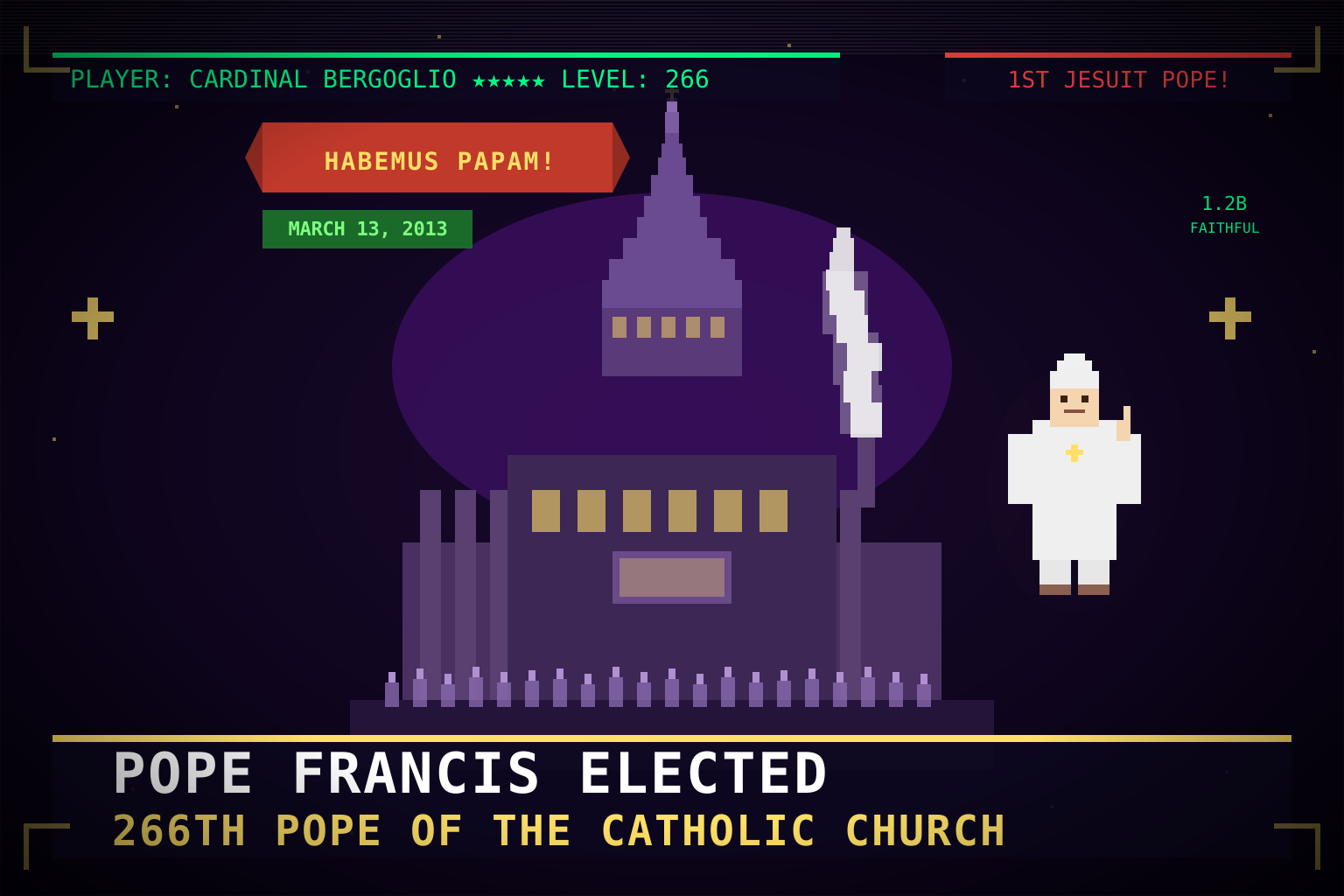
Key figures: Cardinal Jorge Mario Bergoglio, Pope Benedict XVI, Cardinal Timothy Dolan, Cardinal Angelo Sodano, Pope John Paul II
Summary
On March 13, 2013, the College of Cardinals elected Jorge Mario Bergoglio, a 76-year-old cardinal from Buenos Aires, as the 266th Pope of the Roman Catholic Church. Taking the papal name Francis, he became the first pope from the Southern Hemisphere, the first from the Americas, and the first member of the Jesuit order to hold the office. The conclave that elected him lasted just over 24 hours—shorter than most recent papal elections—culminating in white smoke rising from the Sistine Chapel’s chimney at approximately 7:06 p.m. local time. When announced to the crowd gathered in St. Peter’s Square, the name “Francis” surprised many observers, as no previous pope in the Church’s history had ever chosen it.
Bergoglio’s election followed the unprecedented resignation of Pope Benedict XVI on February 28, 2013. Benedict, who had reigned since 2005, had cited advanced age and declining physical strength as reasons for stepping down—the first papal resignation in nearly 600 years (the previous being Pope Gregory XII in 1415). The unexpected announcement set off a flurry of media speculation and theological debate about the future direction of the 1.2-billion-member global Catholic Church during a period marked by declining membership in Western Europe and North America, clergy sexual abuse scandals, financial controversies at the Vatican, and internal doctrinal disputes over issues including contraception, divorce, and LGBTQ+ inclusion.
Bergoglio’s path to the papacy began in Buenos Aires, where he was ordained as a priest in 1969 and joined the Jesuit order. He rose through the ecclesiastical hierarchy to become an archbishop in 1998 and was elevated to cardinal in 2001. During the late 20th century, he had been a politically engaged figure within the Latin American Church, navigating the region’s authoritarian regimes, civil conflicts, and liberation theology debates. His 2013 election signaled a geopolitical and theological recalibration within the Catholic hierarchy.
Early Life and Jesuit Formation
Jorge Mario Bergoglio was born on December 17, 1936, in Buenos Aires to an Italian immigrant family—his father a railway worker and accountant, his mother a schoolteacher and homemaker. He entered the Jesuit novitiate in 1958 and was ordained a priest on December 13, 1969. He completed a licentiate in philosophy at the Colegio Máximo de San José in San Miguel and taught before travelling to Germany in 1986 to research a doctoral thesis on the theologian Romano Guardini at the Sankt Georgen Graduate School in Frankfurt; he was recalled to Argentina before completing the dissertation. Unlike many Latin American bishops of that era, Bergoglio neither publicly championed nor publicly condemned liberation theology; instead, he pursued a middle path that emphasized pastoral work with the poor and marginalized while maintaining institutional loyalty to Rome.
During Argentina’s military dictatorship (1976–1983), Bergoglio’s role remained ambiguous and contested. He was known for ministering to victims and dissidents but was later accused by some human rights groups of insufficient activism in protecting clergy and lay activists from regime violence. He survived multiple threats to his safety during this period.
Buenos Aires Bishopric and Rise to Cardinal
In 1992, Pope John Paul II appointed Bergoglio an auxiliary bishop of Buenos Aires. He became archbishop of Buenos Aires in 1998 and was elevated to cardinal by John Paul II in February 2001 at age 64. As cardinal, he became known for a relatively austere personal lifestyle—he chose to live in a modest apartment rather than the luxurious cardinal residence and took public transportation instead of an official car. His tenure as archbishop saw significant pastoral outreach to poor neighborhoods and expanded social work programs, positioning him as a figure attentive to economic inequality and class divisions within the Church. He also advocated for a stronger Catholic presence in public discourse on poverty, education, and labor rights in Argentina’s post-2001 economic crisis.
The 2013 Conclave
Following Benedict XVI’s resignation on February 28, 2013, the conclave began on March 12. The College of Cardinals numbered approximately 115 eligible electors (those under age 80). The election took five ballots over less than 24 hours. On the first ballot, held the evening of March 12, no candidate achieved the required two-thirds majority. Bergoglio gained substantial support in the subsequent ballots on March 13, emerging as the leading candidate by that afternoon and reportedly drawing at least 90 of the 115 votes on the decisive fifth ballot. At approximately 6:50 p.m., the required majority was achieved. Following a tradition established in the modern era, Bergoglio accepted the election and chose the name Francis.
The choice of name carried symbolic weight. “Francis” alluded to Saint Francis of Assisi, the 13th-century founder of the Franciscan order known for radical poverty, nature mysticism, and peace advocacy—a sharp contrast to the scholarly, contemplative image associated with Pope Benedict XVI. The name suggested that Bergoglio intended to reorient the papacy toward apostolic simplicity, concern for the materially poor, and interfaith dialogue.
Early Papacy and Direction
In his first weeks as pope, Francis departed from immediate predecessors’ practices in visible ways. He declined to wear papal vestments of elaborate ornamentation. He called for renewed attention to the plight of the poor and launched the Vatican’s extensive child sexual abuse investigations and sanctions against offending clergy. He signaled openness to dialogue with divorced and remarried Catholics, LGBTQ+ individuals, and non-Catholic denominations. His inaugural homily on March 19, 2013, stressed pastoral care, mercy, and the Church’s mission to serve the material and spiritual needs of the poor.
Francis also moved to reform the Vatican’s financial systems, establishing commissions to investigate years of controversial financial management and address longstanding scandals involving the Vatican Bank (Instituto per le Opere di Religione). His appointment of an international commission of cardinals to review Vatican finances signaled an unprecedented openness to institutional self-examination.
Significance
Pope Francis’s election marked a watershed moment in the Roman Catholic Church’s institutional history. His selection of a Jesuit signaled a recalibration of power within the Church’s hierarchy, moving away from the conservative theological orientation of the late John Paul II and Benedict XVI papacies. The election of a pope from Argentina—a nation with centuries of Catholic heritage but also characterized by secularization, divorce, and LGBTQ+ activism—suggested a Church leadership increasingly aware of its global membership and declining institutional influence in traditionally Catholic regions.
The 2013 election also illustrated broader demographic shifts within global Catholicism. The growing strength of the Church in the Global South (Latin America, Africa, Asia) relative to its decline in Western Europe and parts of North America meant that the composition of the College of Cardinals reflected a more geographically diverse electorate than in the 1978 election of John Paul II. Bergoglio’s election, in this context, represented the institutional recognition of these shifting tectonic plates in global Christianity.
Within broader 2013 contexts, the Francis papacy emerged at a moment of unprecedented institutional scrutiny of religions and religious authority. The sexual abuse scandals plaguing the Church, the growing secularization of Western societies, and the simultaneous rise of religious nationalism and fundamentalism globally all intersected with the election of a new pope tasked with addressing crises of institutional credibility and relevance.
Recognition: Time Person of the Year 2013
In December 2013, Time magazine named Pope Francis its Person of the Year, citing his rapid reshaping of the Catholic Church’s public image and his emphasis on mercy, poverty, and institutional reform. The award was given just nine months after his election—an unusually swift recognition reflecting the magnitude of his symbolic impact. Time’s editors described him as having “placed himself at the center of the central conversations of our time: about wealth and poverty, fairness and justice, transparency, modernity, globalization, the role of women, the nature of marriage, the temptations of power.” Runner-up candidates included NSA leaker Edward Snowden and Syrian president Bashar al-Assad, whose contrasting 2013 profiles (see NSA Surveillance Revelations) illustrated the range of figures who shaped the year’s global moral landscape.
Historical Firsts
Francis’s election established several historical precedents that marked its singular importance:
- First Jesuit pope in Church history (the Society of Jesus had existed since 1540)
- First pope from the Americas
- First pope from the Southern Hemisphere
- First non-European pope since Gregory III (731–741 AD), a Syrian who served during the Byzantine period
- First pope to take the name Francis, which had never been used by any predecessor in the Church’s two-millennium history
The combination of these firsts signaled that the election represented a genuine discontinuity from recent papal history rather than incremental succession.
2013 Context: Institutional Crises and Reformers
Francis’s election took place in a broader 2013 context marked by crises of institutional authority and demands for structural reform. Just weeks before his election, Hugo Chavez—another major figure who had defined Latin American politics through personality, populism, and challenge to established hierarchies—died on March 5, 2013 (see Hugo Chavez: Death and Legacy). Chavez’s death and Francis’s election within two weeks of each other illustrated the moment’s charged quality in Latin America, as two major institutional formations—the Catholic Church and Venezuelan state socialism—simultaneously confronted questions of succession, reform, and institutional relevance.
Later in 2013, the NSA surveillance revelations (see NSA Surveillance Revelations) further eroded public confidence in major institutions—governmental, legal, and intelligence—creating a broader cultural moment in which figures who could credibly claim moral authority through demonstrated simplicity and service became culturally valuable. Francis’s refusal of luxury vestments, his insistence on paying his own hotel bill after the election, and his continued use of modest transport resonated precisely because these gestures contrasted with the institutional behavior that had generated public distrust.
Malala Yousafzai (see Malala Yousafzai: Education Advocate) represented another 2013 public figure who achieved global significance through moral courage in the face of institutional violence, earning the 2014 Nobel Peace Prize. She and Francis inhabited different institutional roles, but both figured in 2013’s broader conversation about leadership, moral authority, and what institutions owed their most vulnerable members.
See Also
- Hugo Chavez: Death and Legacy — Latin American political transition within weeks of Francis’s election
- Malala Yousafzai: Education Advocate — another 2013 moral authority figure
- NSA Surveillance Revelations — the 2013 institutional crisis that framed the Time Person of the Year shortlist
- Nelson Mandela: Death and Legacy — the other defining people story of 2013