Key figures: Tim Cook (Apple CEO), Phil Schiller (Senior Vice President of Marketing), Craig Federighi (Senior Vice President of Software Engineering), Jony Ive (Chief Design Officer)
Summary
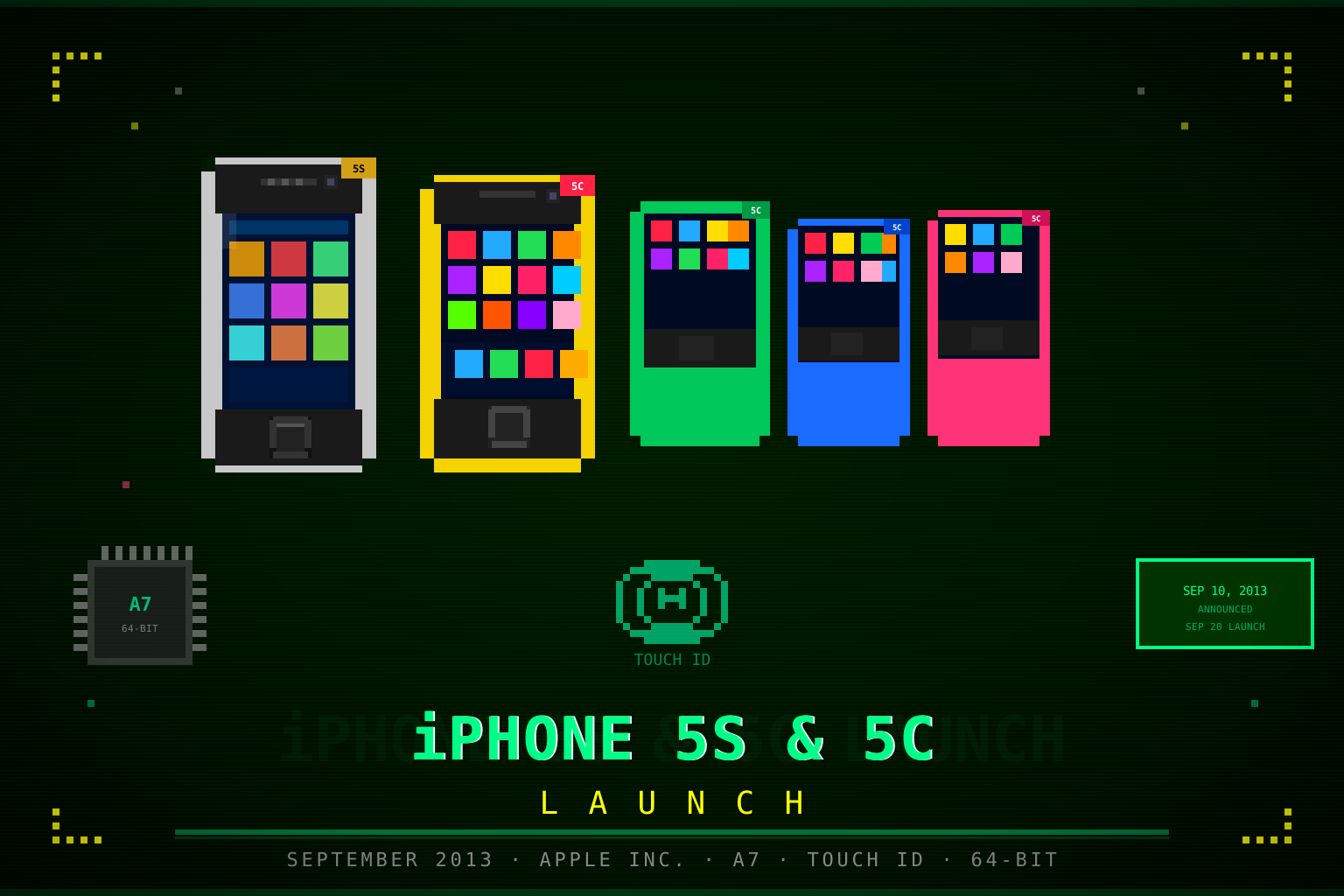
On September 10, 2013, Apple announced two new iPhone models; both were released on September 20, 2013, in initial markets including the United States, United Kingdom, Canada, China, France, Germany, Australia, Japan, Hong Kong, and Singapore. The announcement marked a strategic divergence: the iPhone 5S positioned as the premium flagship model, and the iPhone 5C as an accessible, mass-market alternative differentiated by colorful design and lower pricing.
The iPhone 5S represented the seventh generation of the iPhone. It maintained the iPhone 5’s 4-inch display and aluminum construction—hardware design decisions established during the tenure of late Apple co-founder Steve Jobs—but introduced significant technological innovations. Most significantly, the 5S featured the Apple A7 processor, the first 64-bit processor ever shipped in a smartphone, executing instructions on a 64-bit architecture that competitors would not match for years. The device also introduced Touch ID, a fingerprint-recognition system embedded in the home button that allowed users to unlock the device and authenticate purchases through biometric authentication—a security innovation that would become industry standard.
The iPhone 5C, by contrast, employed a distinctive design philosophy. Rather than aluminum, it used a hard-coated polycarbonate shell available in five colors—blue, green, pink, yellow, and white—with the “C” name explicitly standing for “color.” The 5C retained the processor of the prior-generation iPhone 5 (the A6 chip) but offered the same iOS 7 software experience as the 5S. Priced substantially lower than the 5S ($549 unsubsidized vs. $649 for the 5S base model), the 5C represented Apple’s strategic attempt to capture price-sensitive customers while maintaining brand premium positioning. The 5C weighed 132 grams, making it 20 grams heavier than both the iPhone 5 and 5S despite using lighter materials.
The iPhone Franchise and 2013 Market Context
The iPhone, first released in 2007, had become Apple’s primary revenue driver and a global symbol of smartphone technology. By 2013, Apple commanded approximately 15-17% of the global smartphone market by unit volume but over 70% of smartphone industry profits. The smartphone market itself had undergone fundamental shifts since the iPhone’s debut: the device that once seemed revolutionary for its touchscreen interface and app ecosystem had become mature, with millions of users upgrading annually and competitors (particularly Samsung with its Android-based Galaxy series) establishing serious market presence.
Apple’s 2013 market challenge centered on managing growth in an increasingly saturated market. The prior year had brought the iPhone 5, which introduced a taller 16:9 aspect-ratio display but was regarded as an incremental refinement. The iPhone 4S (2011) had achieved record sales of approximately 70 million units in its initial twelve-month run. By 2013, the company sought to reignite growth momentum through technological differentiation (the 5S’s 64-bit processor and biometric authentication) and market segmentation (the more affordable 5C).
The iOS ecosystem—including the App Store, which had distributed over 1 million applications by 2013—had become integral to iPhone’s competitive advantage. The 5S and 5C both shipped with iOS 7, which represented a dramatic visual redesign by Apple under the leadership of Jony Ive. iOS 7 abandoned the “skeuomorphic” design philosophy that had characterized prior versions (interfaces that mimicked real-world materials like leather, wood, and paper) in favor of a flatter, more minimalist aesthetic emphasizing typography and color. The new interface design proved controversial—some users found it refreshingly modern, while others initially perceived it as cold and less intuitive—but it established a design language that would define Apple’s software platform for years.
The iPhone 5S: 64-Bit Architecture and Touch ID
The A7 processor’s 64-bit architecture represented a significant technological leap. Processing 64-bit instructions provided several advantages: it allowed the processor to work with larger numbers and larger memory addresses, enabling access to more than 4 GB of RAM (the prior-generation A6 processor’s maximum) and potentially faster mathematical operations for certain algorithms. Competitors’ flagship Android processors—including Qualcomm’s Snapdragon 800 and 805—remained 32-bit in 2013, and the industry would not ship comparable 64-bit Android chips until 2014, with parts such as Qualcomm’s Snapdragon 410 and 810 and the 64-bit “Denver” variant of Nvidia’s Tegra K1.
Touch ID, however, represented the more culturally significant innovation. The fingerprint-recognition technology, initially appearing controversial—some privacy advocates raised concerns about biometric data collection and storage—quickly became standard among consumers and established a new security paradigm. Users could unlock their phones and authenticate Apple Pay purchases without entering a passcode, addressing a persistent pain point in mobile usability. The technology relied on a specialized secure enclave within the A7 processor, isolated from the main operating system, to store and process fingerprint data. This architectural choice—ensuring biometric data remained isolated from the general-purpose processor and inaccessible even to Apple—became the model that competitors subsequently adopted.
The iPhone 5S offered three color options: space gray, silver, and gold. The gold finish—often described as champagne or rose gold—proved unexpectedly popular, particularly in China where precious-metal finishes carried cultural significance. Apple had not anticipated the demand surge for gold models and faced initial supply constraints.
The iPhone 5C: Accessible Design and Market Segmentation
The iPhone 5C’s introduction reflected Apple’s strategic challenge in an era of slowing growth. The device’s 8-megapixel rear camera, 1 GB of RAM, and A6 processor were identical to those of the prior-generation iPhone 5 released in 2012. What distinguished the 5C was its exterior design, materials, and price positioning. The polycarbonate shell, produced in bright colors and backed by a steel frame, created a device aesthetically distinct from Apple’s prior premium-materials strategy.
The 5C’s lower price—initially $549 without a wireless service contract—positioned it to capture customers for whom the $649 5S remained unaffordable, particularly in emerging markets like India and Southeast Asia where purchasing power favored lower-cost devices. However, the 5C’s success was mixed. While it appealed to some segments, particularly price-conscious consumers and those attracted to the colorful design, it faced criticism from premium-brand loyalists who viewed it as a compromise and from value-conscious consumers who perceived the polycarbonate construction as inferior to aluminum. Market data would later indicate that the iPhone 5S outsold the 5C by a significant margin, suggesting that consumer preference remained anchored to premium materials and cutting-edge performance even at higher prices.
iOS 7 and the Design Revolution
Both the iPhone 5S and 5C shipped with iOS 7, which Jony Ive had redesigned from the ground up following Steve Jobs’ death. The previous seven versions of iOS employed “skeuomorphism” — visual metaphors drawn from physical objects: the Calendar app used a leather-stitched header, the Notes app resembled a yellow legal pad, the Bookshelf in iBooks displayed realistic wood grain. Ive, who had long clashed with Jobs’ collaborator Scott Forstall over this aesthetic, stripped away every texture and replaced it with a palette of white, translucent layers, and vibrant iOS system colors.
iOS 7’s specific innovations included a new physics engine governing animations and parallax effects (the wallpaper shifted subtly relative to app icons as the user tilted the device), flatter icon designs, Control Center (a pull-up panel for toggling Wi-Fi, flashlight, and screen brightness without navigating through Settings), and the complete redesign of built-in apps including Safari, Mail, and Maps. The redesign was the most significant visual overhaul in iPhone history and influenced mobile operating system aesthetics industry-wide: Google’s Material Design specification (2014) drew on many of the same flat-color, layered-surface principles.
The launch of iOS 7 alongside the 5S and 5C represented the first major consumer product entirely under the aesthetic authority of Ive rather than Jobs. Within the first four days of availability, 200 million devices upgraded to iOS 7 — the fastest iOS adoption rate in Apple’s history to that point — suggesting that the redesign was broadly accepted despite early criticism from some users who found the flatter, lighter typefaces harder to read.
Biometric Authentication and Security Paradigm Shift
Touch ID’s introduction at scale in a mass-market product catalyzed a broader industry shift toward biometric authentication. For decades, the security establishment had debated the merits of biometric systems—fingerprints, facial recognition, iris scanning—as replacements for or complements to passwords. Prior implementations in consumer phones had been uncommon; Samsung had experimented with fingerprint sensors in a few models, but adoption remained marginal.
Apple’s implementation, backed by its ecosystem of controlled hardware and software, made biometric authentication accessible and trusted. By 2016, fingerprint recognition had become a standard feature on flagship Android devices. Facial recognition—which Apple would introduce in the iPhone X (2017)—emerged as the subsequent evolutionary step. The Touch ID system also established a security model that influenced discussions about biometric data collection, privacy, and the distinction between biometric data stored locally on a device and biometric data transmitted to cloud services or third parties.
Market Reception and Industry Response
The September 2013 launch was Apple’s first major product announcement since the death of co-founder Steve Jobs in October 2011. While CEO Tim Cook had led several successful product cycles, the question of whether Apple could remain an innovator under his leadership remained contested. The A7 processor and Touch ID addressed this skepticism by demonstrating genuine technological differentiation—features competitors could not immediately match.
Initial sales figures favored the 5S substantially. Within the first three days, Apple sold over 9 million units of both models combined (a figure that could not distinguish between 5S and 5C sales). By the end of the 2013 calendar year, industry analysts estimated that the 5S represented approximately 60% of unit sales compared to 40% for the 5C, indicating that the premium model’s performance advantage, biometric authentication, and color options (space gray and silver) appealed more broadly than the low-cost positioning alone could justify.
The 5S and 5C represented Apple’s response to the mature smartphone market of 2013. Rather than dominating market share through aggressive pricing (as Samsung pursued in the Android space), Apple pursued margin expansion through technological differentiation and premium positioning—a strategy that would sustain its profitability for years despite smaller unit-volume market share.
Significance
The iPhone 5S and 5C launch crystallized two critical trends in 2013 mobile technology: the architectural shift to 64-bit processors and the normalization of biometric authentication as a security mechanism. Touch ID, in particular, would influence security design across the industry for the subsequent decade, establishing fingerprint and facial recognition as standard features in premium devices and reshaping how users conceptualized authentication and privacy in personal devices.
The dual-product strategy—offering premium and accessible variants—became Apple’s standard approach, with the company releasing multiple iPhone tiers annually thereafter. This segmentation strategy allowed Apple to capture customers across price-sensitivity spectrums while maintaining premium brand positioning for its flagship model.
The iPhone 5S also represented a transitional moment in Apple’s post-Jobs era. The device carried forward design decisions established during Jobs’ tenure (the 4-inch display maintained from the iPhone 5, the aluminum construction) while introducing innovations (64-bit architecture, Touch ID) that established Tim Cook and his engineering leadership as capable of driving meaningful technological progress. For Apple shareholders and observers concerned about the company’s innovation trajectory, the 5S’s reception provided reassurance that the company remained competitive in fundamental technology advancement.
In the broader 2013 technology landscape, the iPhone launch reflected the consolidation of mobile devices as the primary computing platform for billions of users. While personal computers remained important, the smartphone — driven by innovations like Touch ID and the proliferation of applications — had assumed central importance in daily life, productivity, entertainment, and social connectivity. The iPhone 5S and 5C, with their engineering emphasis on biometric security and consumer-friendly design, embodied this transformation.
The 2013 moment also forced reflection on the supply chain behind consumer electronics. The Rana Plaza garment-factory collapse in Bangladesh in April 2013 — see Rana Plaza Building Collapse — had highlighted the human costs of global manufacturing networks. Apple’s own supply chain had faced scrutiny since 2010, when a series of worker suicides at the Foxconn manufacturing complex in Shenzhen, China (Apple’s primary iPhone assembler) prompted investigations into working conditions. By 2013, Apple had committed to third-party audits of its supplier factories through the Fair Labor Association, though labor advocates maintained that compliance remained uneven. The iPhone 5S and 5C were assembled primarily at Foxconn facilities in Zhengzhou and Chengdu, employing a workforce of over 350,000 at Zhengzhou alone during peak production periods.