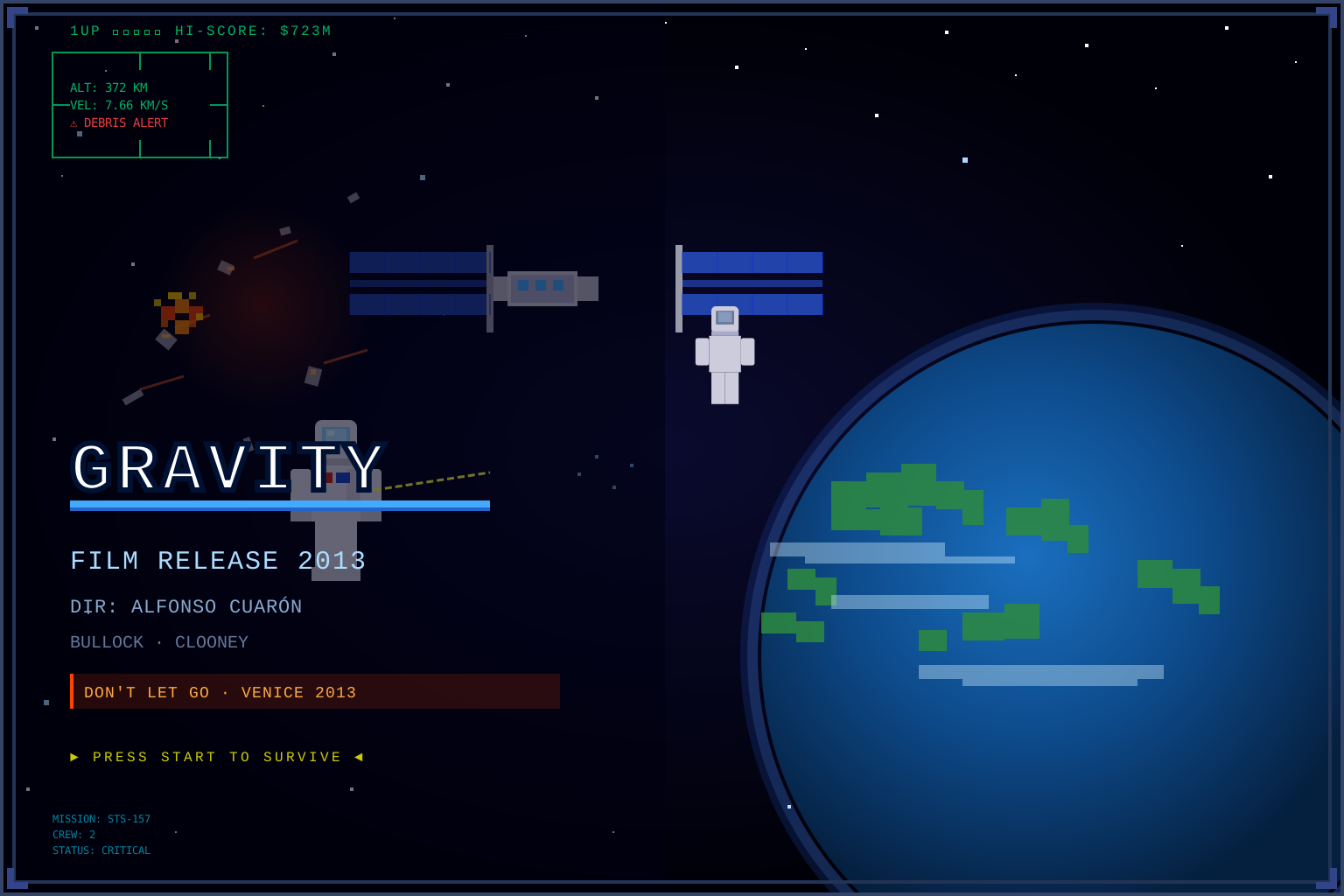
Key figures: Alfonso Cuarón (director, writer, producer), Sandra Bullock (Dr. Ryan Stone), George Clooney (Commander Matt Kowalski), Emmanuel Lubezki (cinematographer), Tim Webber (visual effects supervisor), Steven Price (composer)
Summary
Alfonso Cuarón’s Gravity premiered at the Venice International Film Festival on August 28, 2013, and opened in North American theatrical release on October 4, 2013, establishing itself as one of the most acclaimed and commercially successful films of the year. The space thriller, starring Sandra Bullock as Dr. Ryan Stone and George Clooney as Commander Matt Kowalski, told the story of two astronauts struggling to survive after their Space Shuttle and the International Space Station are destroyed by debris from a Russian satellite explosion.
The film represented a landmark achievement in visual effects and cinematography, employing unprecedented technical innovations to create the illusion of weightlessness in space. Cuarón, who directed, co-wrote, and produced the film alongside his son Jonás Cuarón, had spent four and a half years developing and producing the project—principal photography began in May 2011 and wrapped in late 2011, but post-production and visual effects work consumed nearly two additional years before the 2013 release. The production budget reached approximately $100 million, making it one of the most expensive films of 2013.
Production and Visual Innovation
The LED Volume and Lighting Rig
Gravity pushed the boundaries of filmmaking technology in ways that would influence the entire industry. Cuarón and cinematographer Emmanuel Lubezki, working with visual effects supervisor Tim Webber at Framestore (the London-based VFX house), developed a hybrid approach that inverted conventional filmmaking logic. Rather than placing actors against green screens and adding CGI environments later, the production built space around the actors digitally—then lit the physical performers to match.
The central innovation was a 9-foot mechanical rig that could move in 12 axes, carrying Sandra Bullock through pre-programmed choreography that had been mapped frame by frame to the surrounding digital environment. In parallel, the production employed a roughly 20-foot LED box (nicknamed the “Light Box”) lined with about 1.8 million individual light-emitting diodes capable of reproducing any light pattern—the rotating Sun, Earth, stars, or the reflected glow of burning debris—directly on the performers’ skin. This meant the physical interaction between character and environment light could be captured practically, rather than composited in post-production.
The result was that approximately 80% of the film’s 91 minutes consists of computer-generated imagery, yet the lighting and physicality feel tactile and real. Rendering was among the most computationally demanding visual-effects efforts of its era: Tim Webber and the Framestore team drew on more than 15,000 processor cores and a central storage pool of roughly 1.2 petabytes.
Lubezki’s Long Takes
Emmanuel Lubezki’s camera choreography matched the production’s technical ambitions. The film opens with an uncut sequence of roughly 13 minutes in which the camera moves continuously from wide establishing shots of the shuttle docked at the Hubble Space Telescope to close-up views of characters’ faces, drifting through 360 degrees of space without a single conventional cut. This demanded meticulous pre-visualization and coordination between the live-action camera operators, digital environment artists, and the mechanical rig team, who had to synchronize movements to sub-millimeter tolerances.
Cuarón employed this long-take strategy not merely for technical bravura but to create specific physiological and psychological effects in the audience—particularly a sense of spatial disorientation and dread that would make the eventual moments of explosive action hit with greater force.
Plot and Character Development
Dr. Ryan Stone is a brilliant medical engineer on her first space mission, conducting repairs to the Hubble Space Telescope. Commander Matt Kowalski, a grizzled veteran astronaut played by Clooney with characteristic charisma, leads the mission with casual confidence. Their routine disintegrates when debris from a Russian satellite destroyed in an anti-satellite weapons test collides with their Space Shuttle at relative velocities exceeding 50,000 miles per hour, triggering a catastrophic chain reaction—the Kessler Syndrome, in which collision debris generates additional collisions in an escalating cascade that renders low Earth orbit temporarily impassable.
Stranded in orbit, the two astronauts must navigate toward the International Space Station, then the Tiangong Chinese station, in a desperate bid to find a viable reentry vehicle. Bullock’s performance, which dominates nearly 90% of the film’s screen time, conveyed Stone’s gradual transformation from cautious novice to resourceful survivor—and her arc explicitly parallels a grieving process, since the film reveals early that she had lost a young daughter before the mission. The film’s climax, with Stone’s reentry into Earth’s atmosphere in a Shenzhou capsule, functions as a rebirth sequence with deliberate visual echoes of an infant emerging from amniotic fluid.
Critical Reception
Gravity received extraordinary critical acclaim. It holds a 96% approval rating on Rotten Tomatoes based on reviews aggregated through the awards season. Reviewers praised Cuarón’s technical mastery, Lubezki’s cinematography, Bullock’s performance, and the film’s ability to sustain 91 minutes of tension from a structurally simple scenario. The four-star RogerEbert.com review by Matt Zoller Seitz hailed it as a technical marvel, and critic Richard Roeper ranked it among the year’s best films.
International critics were similarly enthusiastic. The film’s Venice premiere earned a standing ovation and significant critical discussion of Lubezki’s cinematography as a potential Oscar contender—a prediction that proved accurate.
Box Office Performance
Gravity was a major commercial success that exceeded studio expectations:
| Market | Gross |
|---|---|
| Domestic (U.S. & Canada) | $274.1 million |
| International | $449.1 million |
| Worldwide total | $723.2 million |
The film’s opening weekend in North America (October 4–6, 2013) earned $55.8 million—the largest October opening weekend on record at the time, surpassing Paranormal Activity 3 ($52.6 million in 2011), and the best career opening for both Bullock and Clooney. It held the number-one position at the domestic box office for three consecutive weekends, unusual for a non-franchise film without sequel potential.
Worldwide, Gravity ranked as the eighth-highest-grossing film of 2013, behind Disney’s Frozen (released in November 2013), Iron Man 3, Despicable Me 2, The Hobbit: The Desolation of Smaug, The Hunger Games: Catching Fire, Fast & Furious 6, and Monsters University. The release of Frozen the following month gave 2013 two landmark films that would dominate year-end lists.
Awards and Industry Recognition
Gravity dominated awards season in the 2013–2014 cycle, translating critical enthusiasm into record wins for a space-themed film:
- Academy Awards (86th, March 2, 2014): 10 nominations, 7 wins—Best Director (Alfonso Cuarón), Best Cinematography (Emmanuel Lubezki), Best Film Editing (Alfonso Cuarón and Mark Sanger), Best Original Score (Steven Price), Best Sound Mixing, Best Sound Editing, and Best Visual Effects. The film lost Best Picture to 12 Years a Slave and Best Actress to Cate Blanchett (Blue Jasmine).
- BAFTA Awards: 11 nominations, 6 wins including Outstanding British Film and Best Director.
- Golden Globes: Best Director (Cuarón), Best Original Score (Steven Price), and a nomination for Best Motion Picture – Drama.
- Directors Guild of America: Outstanding Directorial Achievement in Feature Film for Cuarón.
- American Cinema Editors: Best Edited Feature Film (Dramatic) for Cuarón and Sanger.
The seven Academy Award wins were the most for any film that did not also win Best Picture since Cabaret (1972), which holds the record with eight. The awards recognized not only Cuarón’s artistic vision but the extraordinary achievements of the Framestore visual effects team, who completed work on the film without a single major production delay despite the unprecedented technical scope.
2013 Film Context
Gravity’s October release placed it in a particularly competitive awards season. Its principal competitors for major awards included 12 Years a Slave (Steve McQueen’s account of Solomon Northup’s enslavement), American Hustle (David O. Russell’s period crime drama), Her (Spike Jonze’s near-future romance), and Nebraska (Alexander Payne’s black-and-white road drama). The 2013 film year also featured The Great Gatsby, Baz Luhrmann’s lavish adaptation whose visual effects and design sensibility—while radically different from Gravity’s—shared a commitment to using digital tools to create immersive period worlds. See also The Great Gatsby film release.
The year’s cultural conversation about visual effects and digital filmmaking was thus shaped by Gravity’s technical achievements alongside other experiments in cinematic craft. Breaking Bad’s series finale, which aired September 29, 2013—five days before Gravity’s release—demonstrated that 2013 was a year when visual storytelling across platforms was undergoing significant transformation.
Significance and Influence
Gravity marked a watershed in visual effects cinema. The LED volume approach pioneered by Cuarón and Lubezki directly influenced the production design of later projects, most notably the “StageCraft” LED volume technology used in The Mandalorian (2019–), which borrowed and industrialized the core principle of lighting performers with physically accurate environmental light rather than green-screen compositing.
The film’s technical achievements combined with its emotional resonance—Bullock’s solo performance carrying the film through its longest sequences—positioned it as one of the most important films of the 2010s. Gravity also made a compelling case for theatrical exhibition at a time when streaming and home entertainment competition was intensifying, since its immersive visuals and spatial sound design gained significantly from large-format presentation.
The film’s meditation on isolation, survival, and return resonated with 2013’s cultural anxieties. In the same year that Edward Snowden’s asylum in Russia focused global attention on questions of refuge, vulnerability, and the limits of state power, Gravity’s Dr. Ryan Stone embodied a different kind of statelessness—physical, cosmic, beyond any nation’s reach—and her survival through ingenuity and will offered a counterweight to those anxieties.
Sources
- Gravity (2013 film) — Wikipedia
- 86th Academy Awards — Wikipedia
- Alfonso Cuarón — Wikipedia
- Emmanuel Lubezki — Wikipedia
- Framestore’s work on Gravity — Framestore official
- Making ‘Gravity’: How Filmmaker Alfonso Cuarón Created ‘Weightlessness’ Without Spaceflight — Space.com
- Box Office Mojo: Gravity (2013)