Key figures: George Zimmerman (neighborhood watch volunteer, defendant), Trayvon Martin (shooting victim, age 17), Judge Debra Nelson (presiding), Angela Corey (state special prosecutor), Bernie de la Rionda (lead prosecutor), Mark O’Mara and Don West (defense attorneys), Alicia Garza, Patrisse Cullors, and Opal Tometi (co-founders of Black Lives Matter)
Background: The Shooting
On February 26, 2012, George Zimmerman, a 28-year-old neighborhood watch volunteer in the Retreat at Twin Lakes gated community in Sanford, Florida, shot and killed Trayvon Martin, a 17-year-old Black high school student from Miami Gardens who was visiting relatives in the community. Martin was returning from a convenience store carrying iced tea and Skittles when Zimmerman spotted him, called the Sanford Police Department non-emergency line, and described Martin as “a real suspicious guy.” Despite the dispatcher’s instruction not to follow the individual, Zimmerman left his vehicle. A confrontation between the two followed; Zimmerman shot Martin once in the chest at close range with a 9mm handgun. Martin died at the scene.
Sanford police initially declined to arrest Zimmerman, citing Florida’s Stand Your Ground law, which permits a person to use force — including deadly force — when they reasonably believe themselves to be in imminent danger of death or great bodily harm, without any obligation to retreat first. Zimmerman’s claim that Martin had attacked him first and was slamming his head against the pavement was not immediately challenged, and he was released the same night.
The Path to Trial
The Sanford Police Department’s decision not to arrest Zimmerman immediately drew widespread criticism and protest. The case gained national media attention in March 2012 after Martin’s parents, Tracy Martin and Sybrina Fulton, launched a public advocacy campaign — aided by attorneys Benjamin Crump and Daryl Parks — calling for Zimmerman’s arrest. An online petition demanding his arrest gathered more than two million signatures.
On March 22, 2012, Sanford Police Chief Bill Lee temporarily stepped down amid the controversy. Florida Governor Rick Scott appointed special prosecutor Angela Corey on March 22, 2012. On April 11, 2012 — 45 days after the shooting — Corey charged Zimmerman with second-degree murder. Zimmerman turned himself in and was held without bail initially before being released on bond. He pleaded not guilty.
The Trial
The trial of George Zimmerman began on June 24, 2013, in Sanford, Florida, presided over by Judge Debra Nelson. Jury selection — which drew criticism for the nearly all-white composition of the six-person panel — concluded on June 20, 2013. The prosecution argued that Zimmerman had profiled Martin as a criminal based on his race, pursued him against police advice, and had no legitimate claim of self-defense. The defense argued that Zimmerman had acted in lawful self-defense after Martin attacked him, and that the prosecution could not disprove this beyond a reasonable doubt.
Key evidentiary disputes included the reliability of witness Rachel Jeantel, a friend of Martin’s who was speaking with him by phone in the moments before his death; the forensic evidence concerning the gunshot wound’s proximity; and recordings of screams on a 911 call during the altercation, which experts and witnesses disputed belonged to either Martin or Zimmerman.
The trial lasted approximately three weeks. Closing arguments concluded on July 12, 2013.
The Verdict
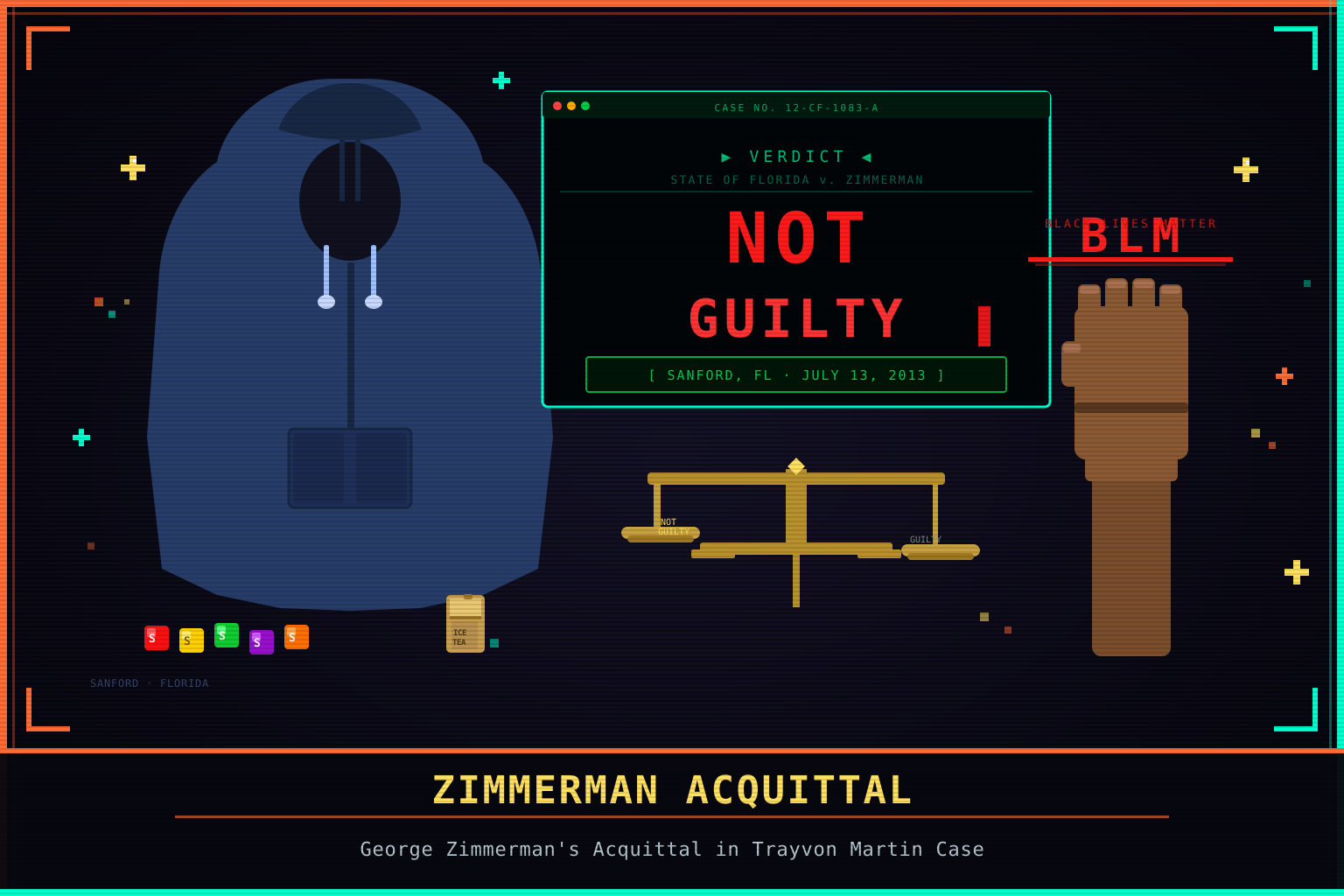
On July 13, 2013, at approximately 10:00 p.m. Eastern Time, the six-woman jury — after approximately 16 hours and 20 minutes of deliberation over two days — returned a verdict of not guilty on all counts: not guilty of second-degree murder, and not guilty of the lesser included charge of manslaughter. The verdict was unanimous; all six jurors voted to acquit.
The jury’s decision reflected the legal standard of proof beyond a reasonable doubt as applied to a self-defense claim. One juror, identified publicly only as “Juror B37,” gave an interview to CNN’s Anderson Cooper shortly after the verdict stating that the jury believed Zimmerman’s “heart was in the right place” and that he did not act with criminal intent.
Immediate Reaction
News of the verdict spread rapidly via social media and traditional media. Protests erupted in cities across the United States, including New York, Los Angeles, Chicago, Atlanta, Oakland, and Washington, D.C. President Barack Obama issued a statement on July 14, 2013, calling the death of Trayvon Martin a tragedy and urging “calm reflection.” In a subsequent July 19 statement, Obama spoke more personally, saying: “Trayvon Martin could have been me 35 years ago” — a remark that drew significant attention and was widely quoted.
On the night of the verdict, July 13, 2013, Alicia Garza wrote a Facebook post she described as “a love letter to Black people,” which ended with the phrase “Black lives matter.” Her friend Patrisse Cullors shared the post with the hashtag #BlackLivesMatter. Opal Tometi joined them in building out the organizational framework. The three women are credited as the co-founders of the Black Lives Matter movement, which would grow substantially over the following years.
Legal and Policy Significance
The Zimmerman acquittal renewed national debate about Stand Your Ground laws, which had been adopted by more than 30 states following Florida’s 2005 enactment of the statute. Critics argued the laws created ambiguity that advantaged shooters claiming self-defense, particularly in cases involving racial disparities in who was perceived as a threat. Florida’s Stand Your Ground law had not been formally invoked as a defense at trial — the defense relied on traditional self-defense principles — but the law had been central to the initial decision not to arrest Zimmerman in 2012, and the jury was instructed that Zimmerman had no duty to retreat.
The U.S. Department of Justice opened a federal civil rights investigation into the case in 2012, seeking to determine whether Zimmerman had acted with racial animus in violation of federal hate crime statutes. The investigation was closed in February 2015 without federal charges, citing the high evidentiary standard required for a federal hate crime prosecution.
Legacy: Black Lives Matter and Civil Rights Activism
The Zimmerman verdict is widely identified as the catalytic event for the modern Black Lives Matter movement and a turning point in twenty-first-century civil rights activism. The phrase #BlackLivesMatter, born on the night of the verdict, became the organizing slogan for a decentralized network of activists and local chapters that emerged primarily in response to subsequent high-profile police killings of Black Americans — including the deaths of Michael Brown in Ferguson, Missouri (August 2014), Eric Garner in New York City (July 2014), and Freddie Gray in Baltimore (April 2015).
By the time of the 2020 protests following the killing of George Floyd, Black Lives Matter had become one of the most recognized civil rights movements in American history, with polling in mid-2020 suggesting that between 15 and 26 million people had participated in related demonstrations — potentially the largest protest movement in U.S. history.
See Also
- Boston Marathon Bombing — another major event of 2013 that focused national attention on public safety and justice
- Edward Snowden’s NSA Revelations — a concurrent 2013 controversy raising civil liberties questions
- US Government Shutdown and Debt Ceiling Crisis — the political climate of 2013
Sources
- Murder of Trayvon Martin — Wikipedia
- Black Lives Matter — Wikipedia
- George Zimmerman acquitted in Trayvon Martin death — Reuters
- Zimmerman Not Guilty of Murder in Trayvon Martin Killing — BBC
- Obama: ‘Trayvon Martin Could Have Been Me’ — NPR
- Stand Your Ground Laws — National Conference of State Legislatures