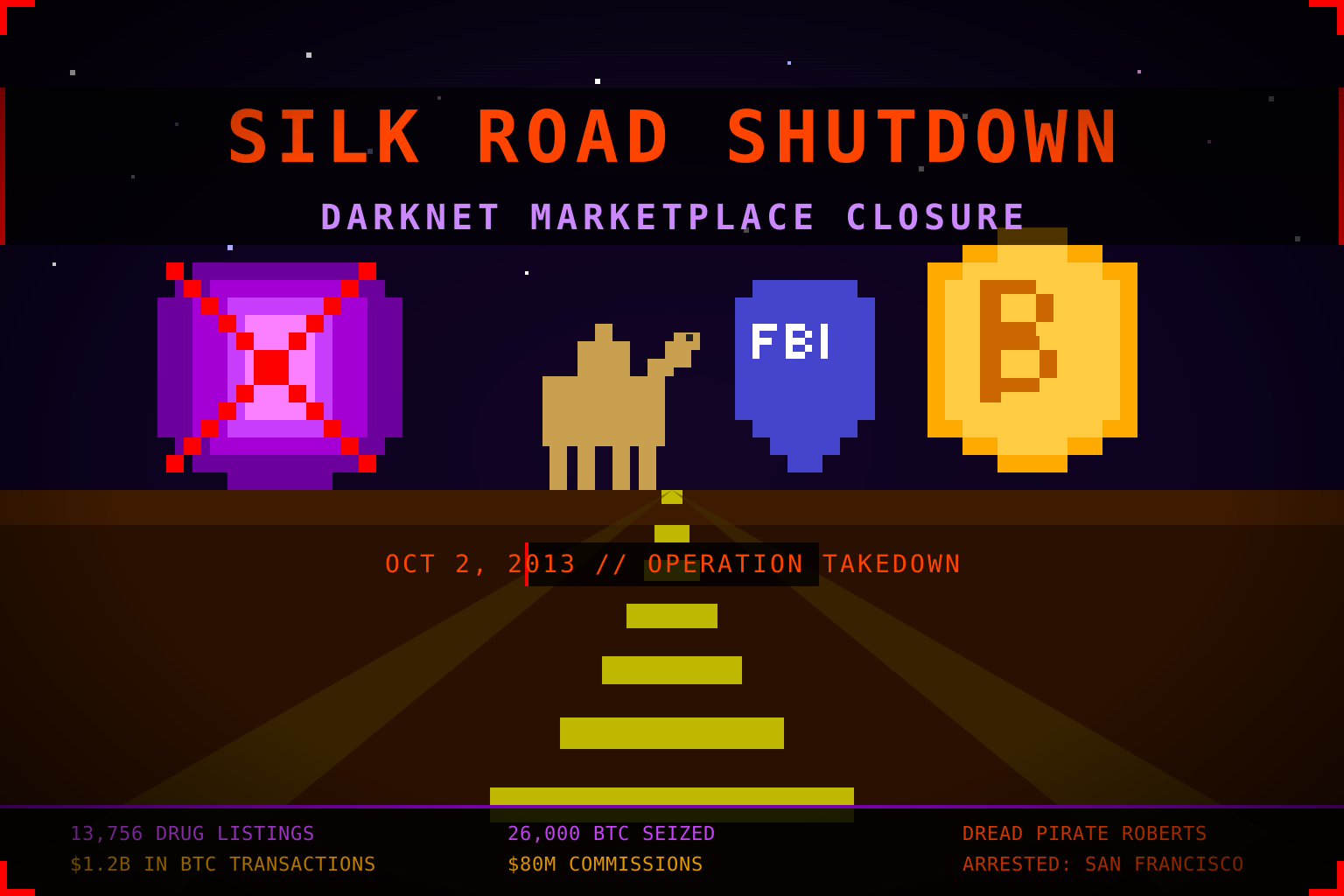
Key figures: Ross Ulbricht (“Dread Pirate Roberts,” Silk Road founder, born March 27, 1984); Jared Der-Yeghiayan (U.S. Postal Inspection Service, lead undercover investigator); Christopher Tarbell (FBI Supervisory Special Agent, New York field office); U.S. Attorney Preet Bharara (Southern District of New York, lead prosecutor); Gary Alford (IRS Criminal Investigation, identified Ulbricht via early forum posts)
Summary
On October 2, 2013, agents from the Federal Bureau of Investigation (FBI), Drug Enforcement Administration (DEA), and Internal Revenue Service Criminal Investigation (IRS-CI) shut down the Silk Road — the most prominent online darknet marketplace for illegal drugs and contraband — and arrested its founder, Ross William Ulbricht, 29, at the Glen Park Branch Library in San Francisco. The shutdown represented the largest law enforcement action against a darknet marketplace to that date and demonstrated that federal agencies had developed meaningful capacity to identify, infiltrate, and prosecute sophisticated digital criminals operating on anonymity-focused networks.
At the time of closure, the Silk Road hosted approximately 13,756 active drug listings across more than 1,100 active vendors; had processed an estimated $1.2 billion in cumulative Bitcoin transactions over its 2.5-year operation; and had generated approximately $80 million in commission revenue for Ulbricht. The FBI seized approximately 26,000 Bitcoin from Ulbricht at arrest, then worth approximately $3.6 million at October 2013 Bitcoin prices. (A subsequent seizure in 2020 recovered 69,370 Bitcoin — by then worth approximately $1 billion — from an associated wallet.) The Silk Road’s closure marked the end of the first major era of darknet commerce and permanently altered law enforcement’s approach to cryptocurrency-enabled crime.
Origins and Founding Philosophy
Ross Ulbricht was born in Austin, Texas, on March 27, 1984. He earned a Bachelor of Science in physics from the University of Texas at Dallas and pursued a Master’s degree in materials science at Pennsylvania State University before withdrawing. Ulbricht’s ideological framework was rooted in libertarian philosophy — particularly the writings of Ludwig von Mises, Murray Rothbard, and the Austrian School of economics — combined with a conviction that drug prohibition caused greater social harm than drug use itself. He later cited these beliefs in a journal he kept during the operation of the Silk Road, which prosecutors introduced at trial.
Ulbricht conceived of the Silk Road as a voluntary free market: a platform where adults could transact without government interference, protected by cryptographic anonymity rather than coercive state enforcement. He began developing the site in late 2010, teaching himself web development, server administration, and Bitcoin integration, and launched the Silk Road in February 2011 as a Tor hidden service. The site gained attention in June 2011 when Senator Chuck Schumer (D-NY) and Senator Joe Manchin (D-WV) wrote to the DOJ and DEA demanding the site be shut down — publicity that substantially increased Silk Road’s user base.
Platform Architecture and Operations
The Silk Road operated on two overlapping anonymization technologies:
The Tor Network
Tor (The Onion Router) routes internet traffic through a series of encrypted relay nodes worldwide, obscuring the origin and destination of data. Traffic entering the Tor network is wrapped in multiple encryption layers, each peeled off at successive relay nodes, so no single relay knows both sender and recipient. Tor was originally developed by the U.S. Naval Research Laboratory in the 1990s and later open-sourced; it is widely used by journalists, activists, privacy researchers, and government whistleblowers, as well as criminal actors. The Silk Road operated as a “hidden service” accessible only within the Tor network — its IP address was never exposed to the open internet.
Bitcoin
Bitcoin, introduced by the pseudonymous Satoshi Nakamoto in 2009, provided a decentralized payment system without banks or payment processors that might respond to law enforcement subpoenas. The Silk Road used a Bitcoin escrow system: buyers sent Bitcoin to the Silk Road’s wallet; upon confirmed delivery, the Silk Road released payment to the seller, retaining a commission of approximately 8–15% (lower for high-volume vendors, higher for small transactions). This design gave the Silk Road custody of substantial Bitcoin at any moment and kept buyer and seller identities separated.
Marketplace Design
The Silk Road borrowed extensively from legitimate e-commerce design:
- Vendor reputation ratings: Buyers rated transactions; cumulative ratings built vendor reputation. High-reputation vendors could charge price premiums.
- Dispute resolution: The Silk Road offered human arbitration for disputed transactions; Ulbricht (as “Dread Pirate Roberts”) and trusted moderators adjudicated disputes.
- Harm reduction emphasis: Ulbricht maintained a forum attached to the marketplace where users shared drug safety information, dosing guides, and harm-reduction advice — framing the Silk Road partly as a public health alternative to the street drug market.
- Prohibited categories: Ulbricht’s terms of service prohibited sales of weapons, human trafficking, child sexual abuse material, and materials designed to harm third parties — positioning the site as a marketplace for consensual adult drug use, not broader criminality.
Scale and Activities
At closure, law enforcement analysis of seized Silk Road records documented:
- Active drug listings: approximately 13,756 listings
- Active vendors: approximately 1,110 vendors registered as active sellers
- Cumulative transactions: approximately 1.22 million completed transactions over the marketplace’s lifetime
- Revenue to Ulbricht: estimated $79.8 million in Bitcoin commissions
- Primary categories: Approximately 70% of listings were narcotics (cannabis, MDMA, stimulants, opiates, psychedelics); approximately 13% were forged documents; the remainder were other services
- Geographic distribution: The majority of vendors claimed US or European addresses; drugs were shipped via international mail, typically concealed within innocuous packages
The Silk Road achieved a level of consumer protection rare in the street drug market: most buyers received what they ordered, at labeled purity, without violence. Whether this represented net harm reduction or net harm amplification remains debated by public health researchers.
Investigation: How Ulbricht Was Identified
The FBI investigation began in late 2011 and involved multiple parallel threads:
Gary Alford’s Forum Discovery (IRS-CI)
IRS Criminal Investigation agent Gary Alford, reviewing early Silk Road-related internet posts, identified a post by a user named “altoids” on the forum Shroomery.org from January 2011 — just before the Silk Road launched — promoting what would become the marketplace. The same “altoids” username appeared in a Stack Overflow programming forum post in which the user asked for programming help with the “Tor-based marketplace” and included a Gmail address: rossulbricht@gmail.com. This link between the Silk Road’s pre-launch promotion and a real identity was a critical breakthrough, though the full chain of evidence connecting Ulbricht to “Dread Pirate Roberts” required extensive additional investigation.
Postal Inspector Der-Yeghiayan’s Infiltration
U.S. Postal Inspector Jared Der-Yeghiayan — based in Chicago and assigned to investigate drug shipments through O’Hare International Airport — began investigating Silk Road-shipped packages in 2012. By mid-2013, Der-Yeghiayan had established an undercover identity on the Silk Road, eventually rising to become a trusted Silk Road administrator under the alias “cirrus.” In this capacity, he had access to the Silk Road’s internal messaging system, transaction logs, and communications with Ulbricht — providing invaluable intelligence on the marketplace’s operations and Ulbricht’s management patterns.
Bitcoin Blockchain Analysis
While Bitcoin is pseudonymous (transactions are linked to wallet addresses, not names), the blockchain is a permanent, fully public ledger. Law enforcement analysts, working with academic blockchain researchers, developed techniques to trace Bitcoin flows from Silk Road accounts to known exchange accounts — particularly Mt. Gox and Bitstamp — where users had submitted identity documentation under anti-money laundering regulations. By correlating blockchain transaction patterns with known accounts, investigators traced commissions and vendor payouts to exchangeable addresses that linked to identifiable individuals.
OPSEC Failures by Ulbricht
Despite sophisticated precautions, Ulbricht made a series of operational security (OPSEC) errors:
- The “altoids”/”rossulbricht@gmail.com” connection described above
- Using personal email in Silk Road business communications
- Hiring vendors and administrators via internal messaging, creating transaction trails
- Keeping a detailed journal on his personal laptop describing Silk Road operations, expenses, and his role as “Dread Pirate Roberts”
- Logging into the Silk Road administrative interface from an IP address that was not always Tor-protected
- Contracting with individuals for programming work and paying in Bitcoin, creating traceable transactions
The Arrest: October 2, 2013
Federal investigators in San Francisco, working from a coordinated operation across the FBI (New York), IRS-CI, DEA, and the U.S. Postal Inspection Service, identified Ulbricht’s location through surveillance. At approximately 3:15 PM local time on October 2, 2013, agents entered the Glen Park Branch Library at 2825 Diamond Street, San Francisco, where Ulbricht was using a laptop to manage Silk Road. Agents had choreographed the arrest to occur while Ulbricht was logged in and authenticated to the Silk Road administrative interface, ensuring that the laptop would be in a decrypted, active state at seizure — bypassing full-disk encryption that would otherwise prevent access to its contents.
Ulbricht was approached from two directions; agents staged a mock argument nearby to distract him momentarily; the laptop was seized before Ulbricht could trigger his security protocols. The laptop contained:
- Ulbricht’s personal journal detailing Silk Road operations
- A spreadsheet tracking Bitcoin transactions and expenses
- Extensive private message logs from the Silk Road’s internal system
- The private cryptographic keys to the Silk Road’s Bitcoin wallets
At arrest, Ulbricht was charged with narcotics trafficking conspiracy, continuing criminal enterprise, computer hacking conspiracy, money laundering conspiracy, and operating an unlicensed money transmission business. The DOJ seized approximately 26,000 Bitcoin from Ulbricht’s personal wallet at arrest, worth approximately $3.6 million at the time.
Trial, Conviction, and Sentencing
Ulbricht’s trial commenced on January 13, 2015, in U.S. District Court for the Southern District of New York before Judge Katherine Forrest. The prosecution presented:
- Ulbricht’s personal journal as direct evidence of his role as “Dread Pirate Roberts”
- Blockchain analysis tracing millions of dollars in commissions
- Server logs and IP evidence linking administrative actions to Ulbricht’s physical locations
- Testimony from undercover agents who had communicated with “Dread Pirate Roberts”
The defense argued that Ulbricht had founded the Silk Road but had turned it over to others, and that he had been framed as “DPR” by the true operators. On February 4, 2015, the jury convicted Ulbricht on all seven counts after deliberating for approximately 3.5 hours.
On May 29, 2015, Judge Forrest sentenced Ulbricht to life imprisonment without parole — the maximum possible sentence — plus additional concurrent sentences on individual counts. Forrest cited the scale of the operation, the deaths connected to Silk Road-purchased drugs, and the need for deterrence. The sentence was upheld by the Second Circuit Court of Appeals in 2017.
The Bitcoin Seizure’s Aftermath
The October 2013 seizure of 26,000 Bitcoin was worth approximately $3.6 million at the time. The U.S. government auctioned those Bitcoin in June 2014, with venture capitalist Tim Draper purchasing the full lot of 29,655 Bitcoin (including additional seized coins) for approximately $19 million.
In November 2020, the DOJ recovered an additional 69,370 Bitcoin worth approximately $1 billion at the time — funds held by an anonymous hacker who had stolen them from the Silk Road around 2013. These were auctioned in 2021, generating approximately $1.4 billion for the U.S. Treasury, making the Silk Road case’s total Bitcoin recovery one of the largest asset forfeitures in DOJ history.
Immediate Aftermath: Successor Marketplaces
The Silk Road’s closure prompted rapid proliferation of successor darknet markets:
- Silk Road 2.0 launched within weeks (November 2013), run by former Silk Road moderators using the same Tor hidden-service model. It was itself shut down in November 2014 in a coordinated Europol/FBI operation (“Operation Onymous”).
- Agora and Evolution marketplaces emerged as major Silk Road 2.0 competitors and, by 2014–2015, surpassed its scale.
- AlphaBay (launched 2014, shut down July 2017) became the largest successor marketplace with an estimated $600,000 to $800,000 in daily sales at peak, dwarfing the original Silk Road.
The proliferation demonstrated that the Silk Road’s model — Tor hidden services, Bitcoin escrow, reputation systems — was easily replicable and that market demand was largely inelastic to individual marketplace closures.
Impact on Cryptocurrency Development and Regulation
The Silk Road investigation had lasting effects on cryptocurrency markets and policy:
- Bitcoin’s forensic vulnerability confirmed: The blockchain analysis used to trace Silk Road transactions undermined the claim that Bitcoin was effectively anonymous. This spurred development of privacy-focused cryptocurrencies: Monero (launched April 2014) and Zcash (launched October 2016) implemented cryptographic techniques to obscure transaction amounts and addresses.
- Cryptocurrency regulation: The Silk Road case prompted FinCEN, the Treasury’s financial intelligence unit, to issue guidance in March 2013 (before the shutdown) clarifying that cryptocurrency exchanges operating in the US must register as Money Services Businesses and comply with anti-money laundering rules. The shutdown reinforced pressure for regulation.
- Blockchain forensics industry: The investigation pioneered blockchain analytics techniques that became the foundation for companies including Chainalysis (founded 2014) and CipherTrace — firms that today generate hundreds of millions in annual revenue providing blockchain forensic services to law enforcement and financial institutions worldwide.
Broader Significance
The Silk Road case was simultaneously a law enforcement success, a drug policy flashpoint, and a milestone in the evolution of digital commerce:
- Drug policy debate: The Silk Road’s structured reputation system, harm-reduction forum, and prohibition on violence arguably produced a less dangerous drug market than street-level distribution. Some public health researchers noted that drug-related deaths reported on the Silk Road involved primarily pre-existing risky drug use patterns rather than marketplace-induced harm. This observation fueled ongoing debate over whether regulated illegal drug markets could reduce harm — a debate directly relevant to cannabis legalization movements advancing simultaneously in Colorado and Washington state in 2012–2013.
- Civil liberties: The Silk Road’s prosecution raised questions about the intersection of First Amendment speech (operating a marketplace, publishing harm-reduction information), Fourth Amendment search and seizure (laptop seizure via social engineering rather than technical bypass), and Sixth Amendment rights (proportionality of sentencing). Ulbricht’s case became a focal point for digital rights advocates and libertarian organizations including the Electronic Frontier Foundation (EFF) and the Cato Institute.
- Law enforcement capacity: The case demonstrated that Tor and Bitcoin were not impenetrable — sophisticated human intelligence (the undercover infiltration), blockchain analysis, and traditional investigative techniques combined to identify and convict an operator who had taken significant technical precautions. This lesson shaped subsequent darknet investigations globally.
For Bitcoin’s broader trajectory as an asset class and speculative vehicle during this same period, see Bitcoin’s Dramatic Price Rise to $1,000, which contextualizes the cryptocurrency environment in which the Silk Road both thrived and collapsed. The same Tor anonymity network that shielded the Silk Road was, in 2013, at the center of a broader public reckoning with online privacy and state power; see Edward Snowden’s NSA Revelations for the surveillance disclosures that reshaped debates over encryption, anonymity, and government access to digital communications that year.
Sources
- Silk Road (marketplace) — Wikipedia
- U.S. v. Ulbricht: Criminal Complaint (Oct. 2, 2013) — U.S. DOJ, Southern District of New York
- The Silk Road’s Dark Lord — Wired (May 2015)
- Sentencing Memorandum, U.S. v. Ulbricht (2015) — CourtListener
- DOJ Seizes $1 Billion in Bitcoin Linked to Silk Road (Nov. 2020)
- Chainalysis: The Silk Road Case and Blockchain Forensics
- Tor Project: Onion Services
- Silk Road: The Sting — New York Times Magazine (Oct. 2013)