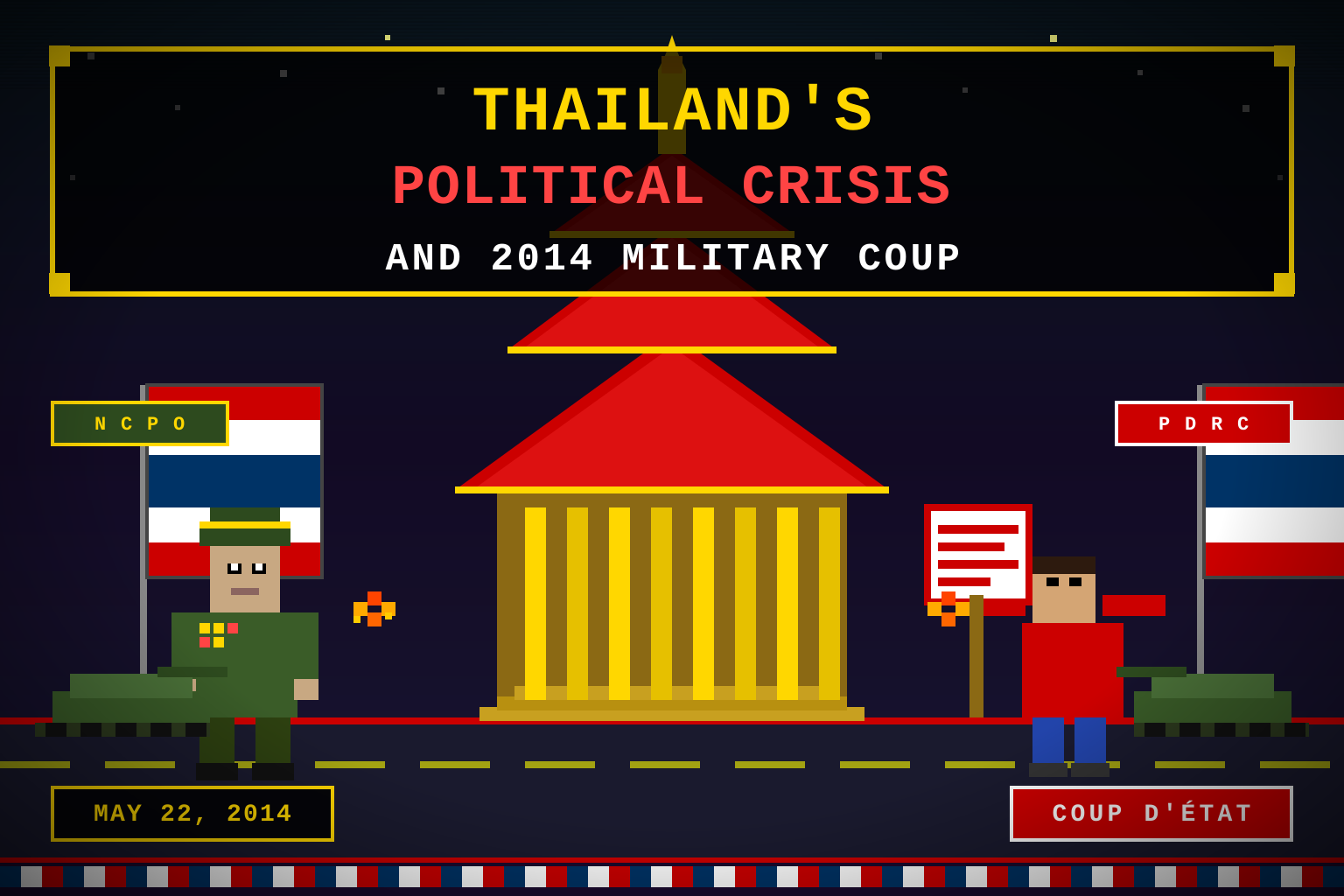
Key figures: General Prayuth Chan-o-cha (Royal Thai Army Commander, NCPO Head); Yingluck Shinawatra (ousted Prime Minister, Pheu Thai Party); Suthep Thaugsuban (opposition protest leader, Democrat Party); Abhisit Vejjajiva (Democrat Party leader, former PM); Thaksin Shinawatra (exiled former PM, political mentor to Yingluck); King Bhumibol Adulyadej (Rama IX, reigning monarch at time of coup)
Summary
Thailand’s most severe political crisis of the decade opened in late 2013. On October 31, 2013, the Pheu Thai-led House of Representatives passed a blanket amnesty bill in an overnight session; the measure triggered mass anti-government demonstrations in Bangkok in the first days of November 2013 and the launch of the People’s Democratic Reform Committee (PDRC) protest movement. Over the following six months the confrontation escalated through the December 2013 dissolution of parliament, a disrupted February 2014 election annulled by the courts, and the May 2014 removal of the prime minister — culminating in a military coup. Because the crisis erupted in and is anchored to 2013, it is recorded here with its 2014 resolution noted as the direct consequence of the 2013 confrontation.
On May 22, 2014, the Royal Thai Army, led by General Prayuth Chan-o-cha, Commander of the Royal Thai Army, staged a military coup d’état that deposed Prime Minister Yingluck Shinawatra’s caretaker government and suspended Thailand’s 2007 Constitution. The coup was Thailand’s twelfth successful coup since 1932 and came after six months of escalating political confrontation — including the “Bangkok Shutdown” protests that began in November 2013, Yingluck’s dismissal by the Constitutional Court on May 7, 2014, and a failed military-mediated reconciliation on May 20. General Prayuth declared martial law nationwide and established the National Council for Peace and Order (NCPO) as the interim governing authority, consolidating military control over the executive, legislative, and judicial branches.
The immediate trigger for the coup’s final phase was the Constitutional Court’s May 7, 2014 ruling removing Yingluck from office for the transfer of a National Security Council official, followed by the resignation of the remainder of the Pheu Thai cabinet. With neither party willing to negotiate a compromise, General Prayuth announced on May 20 that the military was imposing martial law — then, two days later, declared the coup proper, detaining political leaders from both sides at army headquarters.
The coup inaugurated the longest period of military rule in Thailand since 1992, producing a military-drafted constitution ratified in 2016 and elections not held until March 2019. It fundamentally altered Thailand’s political landscape through the end of the decade.
The Political Context: Red Shirts, Yellow Shirts, and the Thaksin Divide
Thailand’s 2014 coup was the culmination of a political conflict rooted in the Thaksin Shinawatra era (2001–2006). Thaksin, a telecommunications billionaire turned politician, won the 2001 and 2005 general elections by large margins through populist policies targeting rural and working-class constituencies: the 30-baht universal healthcare scheme, village development funds, and agricultural price supports. His policies earned him a loyal base in Thailand’s rural north and northeast — known as the “Red Shirts” — while alienating Bangkok-based royalist elites, urban middle classes, the military, and the judicial establishment — broadly the “Yellow Shirt” coalition.
Following the 2006 military coup against Thaksin (his second overthrow; a 2008 Constitutional Court ruling had already removed Thaksin-allied Prime Minister Samak Sundaravej), a pattern emerged: Thaksin-aligned parties continued to win successive elections (2007, 2011) while royalist-military factions used constitutional challenges, court rulings, and street protests to remove them from power between elections.
Yingluck Shinawatra, Thaksin’s younger sister, led the Pheu Thai Party to a landslide victory in the July 2011 general election, winning 265 of 500 parliamentary seats — a comfortable majority. Her government implemented a controversial rice-pledging scheme guaranteeing farmers above-market prices for rice, which cost the government an estimated 500 billion baht (approximately $15 billion USD) and generated allegations of corruption and financial mismanagement. Royalist opponents viewed her administration as a Thaksin proxy designed to secure Thaksin’s return from exile and parliamentary amnesty for his 2008 corruption conviction.
Timeline: From Amnesty Bill to Coup
The direct chain of events leading to the May 2014 coup began with the Amnesty Bill of October–November 2013:
- October 31, 2013: The Pheu Thai-dominated House of Representatives passed in overnight session the “Blanket Amnesty Bill,” which would have nullified convictions and charges against political figures from the 2004–2010 period — including Thaksin’s 2008 corruption conviction, but also military officers responsible for the 2010 crackdown that killed approximately 90 Red Shirt protesters.
- November 1–4, 2013: Mass protests erupted; the government withdrew the bill on November 4, but the damage was done. The opposition People’s Democratic Reform Committee (PDRC), led by former Deputy Prime Minister Suthep Thaugsuban, launched “Bangkok Shutdown” protests calling for the government’s replacement by an unelected “People’s Council.”
- December 9, 2013: Yingluck dissolved Parliament and called new elections for February 2, 2014.
- January 13–February 2, 2014: PDRC protesters physically blocked voter registration and polling stations in Bangkok and southern Thailand in a campaign they called “Shutdown Bangkok.” The February 2 election was disrupted in multiple constituencies; the Election Commission eventually declared results invalid.
- February 2014–May 7, 2014: Thailand operated under a caretaker government without a functional parliament. Multiple Constitutional Court cases challenged the government on various grounds.
- May 7, 2014: The Constitutional Court ruled Yingluck had abused her authority by transferring a National Security Council secretary to another post in 2011 for personal benefit (to appoint a Thaksin loyalist). Yingluck was removed from office; nine other cabinet ministers were removed under the same ruling. The Pheu Thai Party’s Deputy PM Niwatthamrong Boonsongpaisan became acting PM.
- May 20, 2014: General Prayuth declared nationwide martial law under the Martial Law Act of 1914, stating the army was acting to “restore peace and order” but not staging a coup. Political leaders from both sides were summoned to army headquarters for mediation.
- May 22, 2014, 16:30 local time (09:30 UTC): After two days of failed mediation talks, General Prayuth announced on national television that the military had “seized control of the government” and was establishing the National Council for Peace and Order. Thailand’s 2007 Constitution was suspended immediately.
Military Rule and the NCPO (2014–2019)
Following the coup, General Prayuth announced sweeping institutional changes:
- Constitutional suspension: The 2007 Constitution was repealed; an interim charter issued June 22, 2014, granted the NCPO near-absolute executive authority, including under Article 44, which empowered Prayuth to issue legally binding orders without legislative approval or judicial review.
- Dissolution of Parliament and the Senate: All legislative bodies were disbanded; a National Legislative Assembly (NLA), appointed by the NCPO, replaced them.
- Detention of political figures: Approximately 200 politicians, activists, academics, and journalists were summoned to army bases for “attitude adjustment” — periods of detention, typically 1–7 days, involving political counseling. Several figures, particularly outspoken Red Shirt leaders, were held longer; some faced military tribunal charges.
- Media restrictions: The NCPO ordered all television stations to suspend regular programming and broadcast military announcements for approximately 48 hours after the coup. Online content critical of the military or monarchy was subject to blocking; the Computer Crime Act was aggressively enforced.
- Constitutional drafting: A National Reform Council (NRC) and Constitutional Drafting Committee were appointed. A first draft constitution was rejected by the NRC in September 2015; a revised draft was approved in a referendum on August 7, 2016 — in a poll conducted under restrictions on campaigning against the draft — with 61.4% in favor and 38.6% against. The new constitution entrenched military influence through an appointed Senate and altered electoral rules.
- Elections: Delayed repeatedly, elections were finally held on March 24, 2019, under rules written to disadvantage large parties — though the Pheu Thai-affiliated Future Forward Party still performed strongly until it was dissolved by court order in February 2020.
Regional and International Reactions
- United States: The Obama administration suspended approximately $3.5 million in direct military assistance and cancelled planned joint military exercises. Secretary of State John Kerry called for “a prompt return to democracy.” The suspension of aid signaled a cooling of US-Thai military relations, which had been close since the Cold War.
- European Union: The EU suspended political contacts with Thailand and reviewed preferential trade arrangements under the Generalised Scheme of Preferences (GSP).
- ASEAN: Southeast Asian neighbors publicly urged a rapid return to democratic governance but refrained from formal censure, consistent with ASEAN’s non-interference norm.
- China: China did not criticize the coup and maintained normal diplomatic and economic relations. Chinese tourism to Thailand — already a major revenue source — increased as Western tourism dipped, partially offsetting economic impacts.
- Diplomatic recalibration: The coup accelerated Thailand’s strategic drift toward China. By 2015–2016, Thailand was pursuing Chinese arms purchases (submarines, armored vehicles) that partially replaced suspended US military cooperation.
Economic Consequences
Thailand’s economy showed resilience despite the coup’s disruption:
- Thai equity markets (SET Index) fell approximately 3.5% on May 22, 2014, then partially recovered as markets priced in the end of prolonged political uncertainty.
- GDP growth slowed to 0.9% in 2014 (from 2.9% in 2013), partly attributable to coup-related disruption, though the slowing global economy contributed independently.
- Tourism receipts — accounting for roughly 10% of Thai GDP — declined in the immediate post-coup period as Western embassies issued travel advisories, but recovered by 2015 as Chinese tourists offset Western declines.
- The rice-pledging scheme losses (estimated at 500+ billion baht) continued to burden government finances into 2015–2016; Yingluck was subsequently charged with negligence for the scheme’s losses in a separate criminal process and fled Thailand in August 2017 before her verdict, receiving a 5-year prison sentence in absentia in September 2017.
Constitutional Engineering and Political Legacy
The NCPO’s 2017 Constitution — Thailand’s twentieth since 1932 — was deliberately designed to constrain future elected governments and preserve military influence:
- A 250-seat appointed Senate (with 6 seats reserved for military commanders) was empowered to join the elected House in selecting the Prime Minister during a 5-year transitional period, enabling the Senate to override an elected parliamentary majority.
- A mixed-member proportional electoral system fragmented the party landscape, disadvantaging large parties like Pheu Thai that historically won outright majorities.
- The NCPO’s 20-year “National Strategy” — a statutory national plan — bound future elected governments to military-set development and security priorities.
These provisions fulfilled Prayuth’s longstanding goal: to create a “managed democracy” in which electoral outcomes could not threaten the military-royalist establishment’s position. The design was widely noted by comparative politics scholars as a sophisticated example of authoritarian constitutionalism — using constitutional mechanisms to entrench non-democratic outcomes.
Significance in Southeast Asian Democratic Backsliding
The 2014 Thai coup coincided with a regional pattern of democratic erosion across Southeast Asia that accelerated through the late 2010s. Thailand’s model of “managed democracy” — military-drafted constitution, nominally civilian elections, judicial dissolution of opposition parties — was observed with interest by military establishments across the region. Thailand’s trajectory influenced regional debates over election management, constitutional design, and the limits of international democratic conditionality.
The coup also demonstrated that US security relationships in Southeast Asia offered limited protection for democratic norms when vital strategic interests were absent — a lesson noted by regional analysts examining US-ASEAN policy under subsequent administrations.
See also US Government Shutdown and Debt Ceiling Crisis and Edward Snowden’s NSA Revelations for other 2013 episodes of institutional strain and contested state authority, from legislative deadlock in an established democracy to a global reckoning over surveillance and executive power.
Sources
- 2014 Thai coup d’état — Wikipedia
- Thailand coup: May 22, 2014 — BBC News
- General Prayuth announces coup in Thailand — Reuters (May 22, 2014)
- Thailand’s Political Crisis — Council on Foreign Relations
- Thai Constitution 2017 — International IDEA Constitution Tracker
- Thailand: US Suspends Military Aid After Coup — Human Rights Watch (2014)
- Britannica: Thailand — Political History (2014 section)