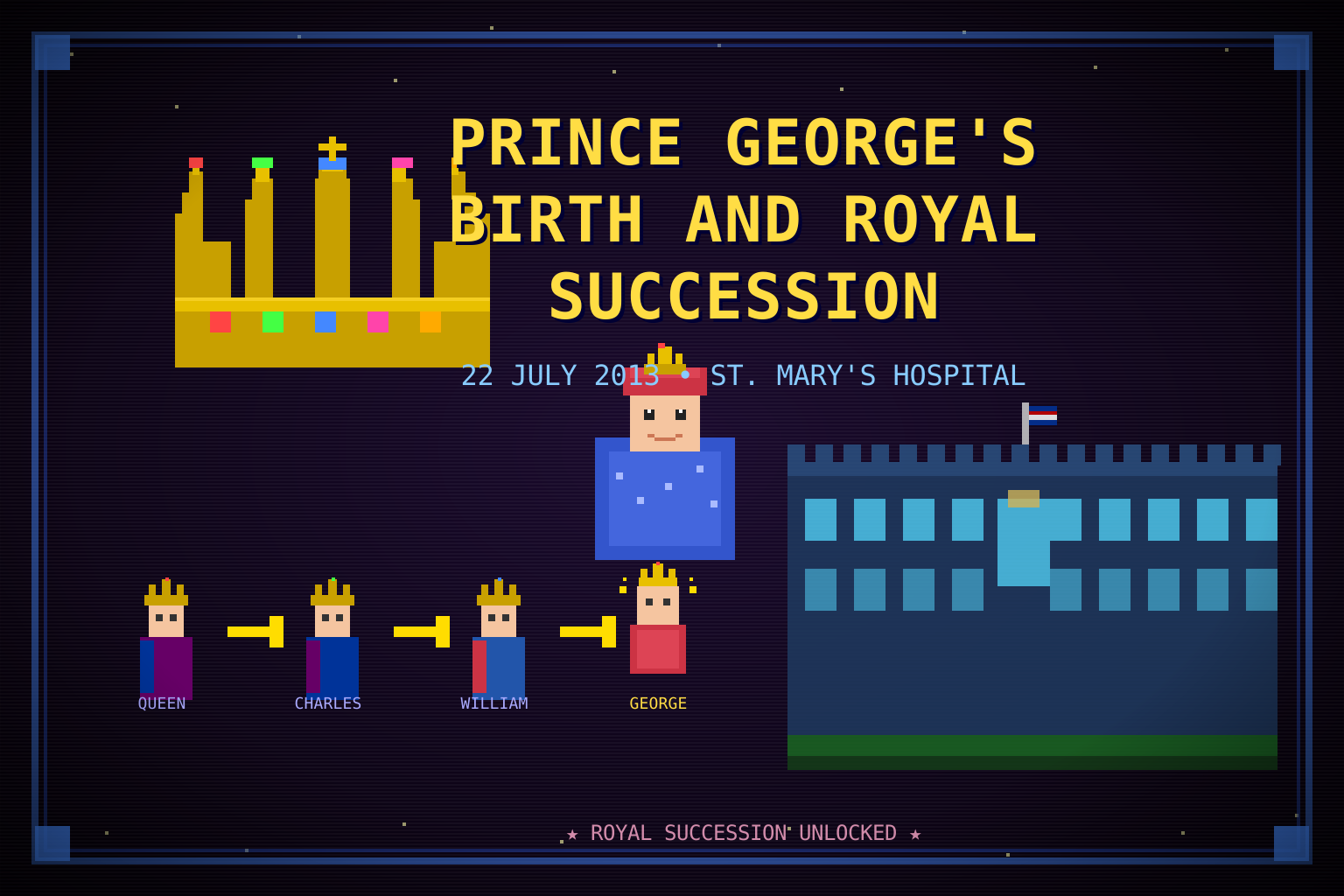
Key figures: Prince George Alexander Louis (newborn), Prince William, Duke of Cambridge (father), Catherine, Duchess of Cambridge (mother), Queen Elizabeth II (great-grandmother), Prince Charles (grandfather), Prince Harry (uncle)
Summary
At 4:24 p.m. on July 22, 2013, Catherine, Duchess of Cambridge, gave birth to Prince George Alexander Louis at St. Mary’s Hospital in Paddington, London. The birth of a son to the Duke and Duchess of Cambridge marked a moment of significant constitutional and cultural importance in the British monarchy and Commonwealth. Prince George, weighing 8 pounds 6 ounces at birth, became third in line to the throne, behind only his grandfather Prince Charles and his father Prince William, and ahead of his uncle Prince Harry.
The birth was announced to the public through formal palace statements and the raising of a notice on the gates of Buckingham Palace, a tradition dating back centuries. The announcement precipitated global media coverage; Prince George’s arrival had been one of the most anticipated births of 2013, drawing comparisons to the intensity of media interest in the births of Prince William himself (1982) and Prince Charles (1948). Media outlets worldwide broadcast continuous coverage, and the birth generated millions of social media posts within minutes.
Prince George’s arrival came less than two years after the wedding of his parents, Prince William and Catherine Middleton, on April 29, 2011. The couple had met at the University of St Andrews in Scotland, and their courtship had become the subject of intense British and international press attention for nearly a decade before their wedding. The announcement of Catherine’s pregnancy in December 2012 had precipitated sustained media speculation about the baby’s sex, name, and future role.
Constitutional and Dynastic Significance
Prince George’s birth held constitutional weight in ways that births of royal children had traditionally carried significance. As third in line to the throne, Prince George represented the continuity of the Windsor dynasty through four generations: Queen Elizabeth II (reigning monarch), Prince Charles (heir apparent), Prince William (second in line), and now Prince George (third in line). The birth also altered the line of succession in ways that had specific historical implications.
Prior to Prince George’s birth, Prince Harry, the Duke of Cambridge’s younger brother, had been third in line to the throne. The law of succession had previously been governed by male-preference primogeniture—under which a younger son displaced his elder sisters in the line. A significant constitutional reform was already in train, however: the Succession to the Crown Act 2013, which had received Royal Assent on April 25, 2013 (though it would not formally come into force until March 26, 2015), replaced male preference with gender-neutral succession for anyone in the line of succession born after the October 28, 2011 Perth Agreement. This meant that if Prince William and Catherine had given birth to a daughter, that daughter would have retained third place in the line of succession—a transformation from historical practice in which daughters automatically fell behind younger sons in the succession order.
The fact that Prince George was male thus rendered moot the full implications of the succession reform, though its passage represented a significant constitutional modernization. Had Catherine given birth to a daughter, the succession would have been genuinely reformed; instead, George’s birth meant that the line of succession followed the familiar male-priority pattern, even as the legal framework for reform was in place.
The Monarchy in Contemporary Context
Prince George’s birth occurred at a moment when the British monarchy was navigating questions of modernization, public relevance, and institutional adaptation. Queen Elizabeth II, reigning since 1952, was 87 years old in 2013 and in her 61st year of reign—making her the longest-reigning British monarch in history (she would surpass Queen Victoria’s 63-year reign in September 2015). The question of succession and the monarchy’s future direction under Prince Charles, and eventually under William, had become subjects of increasing discussion.
Prince William and Catherine’s courtship and marriage had been extensively covered by media and had served as touchstones of cultural interest in the monarchy. The couple were perceived as relatively modern—William had served in the military; Catherine came from a middle-class background, a departure from traditional royal marriage patterns; they had undertaken significant public relations efforts to present the monarchy as accessible and engaged with contemporary concerns.
Prince George’s arrival was thus portrayed in British media and elsewhere as a moment of dynastic continuity but also as evidence that the monarchy was capable of modern family-building and institutional evolution. The naming of the child—George being a traditional royal name (George I through George VI had reigned; multiple princes had borne the name)—signaled respect for historical precedent while the inclusion of Alexander and Louis as middle names provided contemporary personalization.
Birth Circumstances and Public Interest
Catherine’s pregnancy had been marked by significant health complications. She had suffered hyperemesis gravidarum (severe pregnancy sickness) that required hospitalization during the early stages of pregnancy. These health struggles had been publicly acknowledged, leading to broader public discussion of pregnancy-related illnesses and women’s health in the context of extraordinary public attention.
The pregnancy had been announced publicly on December 3, 2012, following Catherine’s hospitalization. The timing of the public announcement—relatively early in pregnancy by contemporary standards, at approximately 12 weeks—was designed to explain Catherine’s brief medical treatment and to preempt media speculation. However, the public announcement also meant that the pregnancy became a subject of intense media and public scrutiny for the following seven months.
The birth itself took place at St. Mary’s Hospital, the same hospital where Prince William had been born in 1982. The choice of hospital connected George’s birth to historical precedent and royal tradition while also selecting a mainstream National Health Service hospital rather than a exclusively private facility—a choice interpreted as evidence of the royal family’s connection to British public institutions.
Prince George was christened on October 23, 2013, at the Chapel Royal, St. James’s Palace, London—a venue that had not been used for a royal christening since Princess Beatrice of York in 1988—in a ceremony attended by family members and godparents chosen from among aristocratic families and close personal friends. The godparents included childhood friends of William and Catherine and representatives of aristocratic families with historical ties to the monarchy.
Gender and Succession Reform
The birth of Prince George occurred against the backdrop of significant gender equality debates within the British monarchy. The Succession to the Crown Act 2013 received Royal Assent on April 25, 2013—shortly before Prince George’s birth—though it did not formally come into force until March 26, 2015, once all sixteen Commonwealth realms had completed their own legislative steps. The Act eliminated male-preference primogeniture, with effect for anyone in the line of succession born after the October 28, 2011 Perth Agreement. Previously, if Prince William and Catherine had given birth to a daughter, that daughter would have been pushed down the line of succession upon the birth of any subsequent son. The reform made succession gender-neutral, meaning that the first-born child would inherit the throne regardless of sex.
This reform was presented as overdue modernization. Princess Charlotte, born in 2015, was the first royal daughter to retain her position in the line of succession upon the birth of a younger brother—a position she would not have held under the previous law. However, the reform’s passage immediately before Prince George’s birth meant that the constitutional issue was somewhat moot in his case, since a son inherited regardless.
The reform had been driven by advocates for gender equality, who had argued that the monarchy could not credibly claim to represent modern values while maintaining a male-preference succession system. The passage of the reform was presented as evidence that even ancient institutions could evolve in response to contemporary demands for equality.
Institutional and Media Context
Prince George’s birth generated unprecedented media interest and public engagement. The labor and delivery of the baby was covered continuously by international news outlets; crowds gathered outside St. Mary’s Hospital; the announcement generated millions of social media posts within minutes. The event became a global phenomenon in ways that transcended British national interest, drawing coverage from news organizations worldwide.
The intense media interest was notable even by the standards of royal births. Some observers attributed the heightened interest to the global reach of digital media and social networks, which had expanded since Prince William’s own birth in 1982. Others noted that the young Duke and Duchess of Cambridge had become global celebrities through intensive media coverage of their courtship, wedding, and early married life—making Prince George’s arrival a moment of genuine cultural significance for international audiences.
Royal commentators noted that the birth represented a generational shift in the monarchy. The Queen had reigned through most of the 20th century; Prince Charles represented a transitional generation; Prince William represented a more contemporary royal generation with experiences of modern education, military service, and marriage to a commoner. Prince George, in this narrative, represented the monarchy’s future and its capacity for institutional evolution.
Economic Impact and Commercial Response
The birth generated an estimated £243 million boost to the British economy, according to analysis by the Centre for Retail Research. This figure included spending on commemorative merchandise—plates, mugs, limited-edition coins, stamps, and novelty items—as well as increased tourism to London and an uplift in purchases of baby-related products triggered by what commentators termed the “royal baby effect.” The Royal Mint issued a commemorative coin; the Post Office released a special stamp set; and hundreds of manufacturers produced licensed and unlicensed souvenir goods.
The economic dimension of the royal birth illustrates the continued commercial potency of the monarchy as a brand. Brand Finance, a consultancy that periodically values the British monarchy as an institution, estimated in 2013 that the royal family contributed approximately £1.8 billion annually to the UK economy through tourism, merchandise, and soft-power trade facilitation. George’s birth, as a generational renewal event, was assessed as amplifying that value further into the medium term.
Commonwealth Dimension
The birth was not merely a British event but a Commonwealth one. As the future monarch of sixteen Commonwealth realms—including Australia, Canada, New Zealand, Jamaica, and Papua New Guinea—Prince George’s birth had constitutional significance across dozens of countries. Each realm had been required to give the gender-neutral succession reforms legal force in its own jurisdiction; the coordinated legislative process across the sixteen realms was itself an administrative achievement, though it was not completed until the reforms came into force in March 2015.
In Australia, polling conducted around the time of the birth showed that approximately 55 percent of the population supported retaining the monarchy, while 35 percent favored becoming a republic—figures that had remained relatively stable throughout the early 2010s. The royal birth, while generating positive media coverage even in republican-leaning publications, did not substantially shift the underlying republican sentiment that had been building in Australia since the 1990s referendum.
Public Celebrations and National Recognition
Prince George’s birth was marked by public celebrations throughout the Commonwealth. In London and other British cities, flags flew at public buildings. The Houses of Parliament held celebrations. Gun salutes—a traditional royal ceremony—were fired in London, Edinburgh, Belfast, and at military installations to mark the birth. The Tower of London became illuminated in celebration.
The public response was broadly positive, though some social commentators questioned whether the intense media interest and celebration reflected genuine public engagement with the monarchy or was instead orchestrated through media machinery and social media algorithms. Nonetheless, the birth appeared to generate genuine popular interest in the monarchy and its future.
Significance
Prince George’s birth marked a watershed moment in the history of the contemporary British monarchy. It represented the continuity of the royal succession through four generations of the same family; it occurred at a moment when the monarchy was navigating questions of modernization and public relevance; and it coincided with significant legal reforms regarding gender and succession.
The birth also illustrated the role of the monarchy as a focus for national identity and continuity. Amid the concerns about economic inequality, institutional distrust, and political conflict that characterized 2013, Prince George’s arrival was presented in media and public discourse as a reassuring moment of dynastic continuity and hope for the future.
The birth further demonstrated the global reach of the British monarchy and its cultural significance beyond Britain itself. News of Prince George’s arrival circulated globally within minutes; international media outlets provided continuous coverage; audiences worldwide engaged with the event through social media. The birth illustrated how the monarchy, while a specifically British institution, had become a subject of global cultural interest and media consumption.
See Also
- Pope Francis Elected as 266th Pope — another major 2013 institutional succession event; the papal election in March preceded George’s birth by four months
- Nelson Mandela’s Death and Legacy — institutional continuity and historical legacy confronted in December 2013, the same year as George’s birth
- Malala Yousafzai’s Education Advocacy — youth and future-oriented 2013 narratives; both George and Malala were prominent figures representing generational futures in 2013
- U.S. Government Shutdown — institutional dysfunction in October 2013 that contrasted with the stability and continuity the royal birth symbolised
- Typhoon Haiyan Disaster — the catastrophic November 2013 event illustrated how quickly global media attention shifts from celebratory to humanitarian narratives
Sources
- Prince George of Cambridge — Wikipedia
- Birth of Prince George — BBC News (July 22, 2013)
- Prince George born to Duke and Duchess of Cambridge — Royal Family Official Website
- Succession to the Crown Act 2013 — UK Parliament
- Gender-neutral succession reform — The Guardian
- Royal baby fever — The New York Times (July 22, 2013)